
Kinso Alternatives 2026
The Kinso app is an AI-powered personal unified inbox that pulls Gmail, Slack, WhatsApp, LinkedIn, and Instagram into one workspace, drafts replies in your voice, and ranks messages by your goals. We re-checked kinso.ai on 23 September 2026: still invite-only and still no pricing page. The waitlist counter now reads 27,300, down from 32,266 on 24 August, so it no longer works as a measure of demand. It is built for one person's own messages, not for a support team sharing a queue.

Messaging-first unified inbox with flat pricing. WhatsApp, Telegram, Messenger, Discord, Zalo in one place.
Zendesk is customer service software and support ticketing system. Best suited for large enterprises needing comprehensive ticketing with compliance requirements and deep third-party integrations. Known for its industry-leading ticketing system with a marketplace of 1,800+ apps, partners and integrations, and enterprise-grade compliance.
Freshdesk is Freshworks' customer support platform, sold as two separate product lines: standard Freshdesk (email-first ticketing, $19-$89/agent/mo) and Freshdesk Omni (messaging plus ticketing, $29-$119/agent/mo). We re-checked both Freshworks pricing pages on 5 August 2026 — the long-running Free plan is gone from the public rate card and survives only as an in-app, six-month, two-agent Free Program on the standard line. Freddy AI is the standout, but Copilot is a $29/agent/mo add-on on top of whichever plan you pick.
Intercom is an AI-first customer service platform best suited for well-funded SaaS companies that want product tours, in-app messaging, and an AI agent that answers front-line questions. Checked 3 August 2026: the three per-seat plans (Essential, Advanced, Expert) still list at $29, $85, and $132 per seat annually, and Fin AI still bills $0.99 per outcome — so the headline seat price is rarely the real cost. Two things did change this year: the company renamed itself Fin in May 2026, and Salesforce signed a definitive agreement to acquire it in June 2026. The helpdesk product keeps the Intercom name.
Help Scout is customer service platform for growing businesses. Best suited for small-medium businesses wanting a clean, email-focused helpdesk with strong knowledge base and self-service features. Known for its docs knowledge base with AI Answers for self-service resolution.
The Kinso app is an AI personal inbox that pulls Gmail, Slack, WhatsApp, LinkedIn, and Instagram into one workspace, drafts replies in your tone, links related messages across platforms, and opens the day with a goal-ranked briefing. It is built by Frank and Jacques Greeff, the brothers behind Realbase, which Domain acquired in 2022 (the National AI Centre's AI Directory puts that exit at $180M). Most people searching for Kinso alternatives are really asking about access, and that has not changed: when we re-checked kinso.ai on 23 September 2026, every Join button still opened a Typeform waitlist rather than a signup screen, and there was still no pricing page.
The waitlist counter now reads 27,300, and this is the first of our four readings that went down: roughly 23,000 in May 2026, 31,196 on 2 August, 32,266 on 24 August, then 27,300 on 23 September. That is 4,966 fewer in a month, shown as a round number where the previous two were exact. A counter that falls is not a running total of signups. Either Kinso let in or removed about 5,000 people, or the figure is set by hand, and the site announces neither. Last month we read the slowing growth between our checks as cooling demand; that reading no longer holds, so treat the number as a marketing line, not a measure of demand or of how long you will wait.
Two dated public records fill in what the marketing site leaves out. The Australian Business Register lists Kinso Operations Pty Ltd (ABN 69 688 081 781) as active from 16 June 2025, a company fifteen months old. The National AI Centre's AI Directory, run by the Australian Department of Industry, Science and Resources, describes the team as ex-Atlassian and ex-Canva engineers and records 13,000+ waitlist signups at the time of its listing. Meanwhile kinso.ai/pricing still returns a 404, so there is no published rate.
Converge is a team customer support platform at $49/month flat for up to 15 agents. These are different product categories: Kinso is a personal productivity tool that unifies an individual's own messages; Converge is a shared team inbox where multiple agents collaborate on customer conversations across WhatsApp, Telegram, Discord, Instagram, Zalo OA, Messenger, X, email from your own mailbox over IMAP/SMTP, and an embeddable chat widget with visitor tracking. That shared-inbox model is the foundation of omnichannel customer support — connecting every channel into one continuous conversation instead of parallel silos.
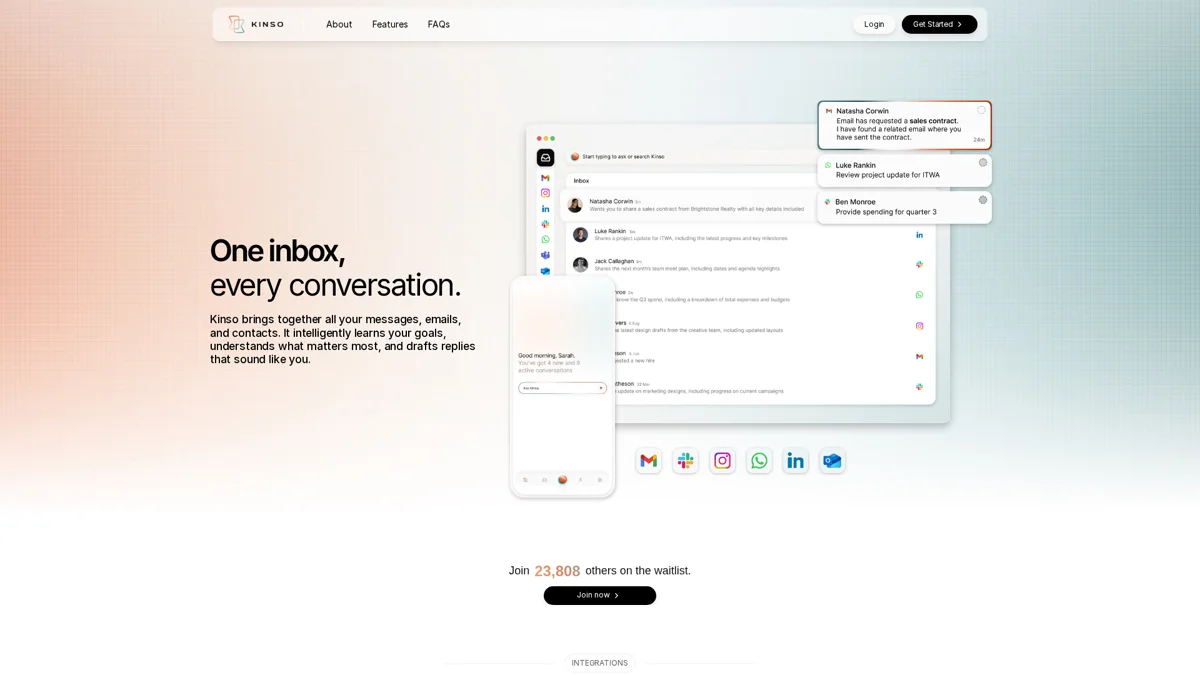
What features does Kinso offer?
Kinso's feature set is built around what its target customer base values most — its biggest differentiator versus the alternatives below. It does not publish its prices, unlike a flat-rate alternative such as Converge ($49/month for up to 15 agents, all channels and AI included). Features typically split across channel coverage, automation depth, AI tooling, and team management — the grid below shows what matters most for a unified-inbox use case.
Why should you look for Kinso alternatives?
Teams look for Kinso alternatives because of structural limitations in its plans and channel coverage — pain points that compound as the team scales past initial setup.
Kinso's feature set centers on personal communication management. The AI drafts replies that match the user's writing tone and style, learned from past conversations across connected platforms (kinso.ai, checked 23 September 2026). Universal search works semantically — users can describe what they're looking for without knowing exact keywords, and Kinso finds it across all connected accounts. The contextual assistant automatically links related messages across platforms: a contract sent on WhatsApp gets paired with the email that requested it. The morning briefing summarizes priority messages and action items ranked by urgency. Kinso tracks conversations as unified "topics" across platforms, so a discussion that starts in email, continues in DMs, and finishes in a group chat appears as one thread.
What data does the Kinso app access, and how long does it keep it?
Kinso's Google integration page documents exactly what the Gmail connection takes, which is unusually specific for a pre-launch product: Gmail read-only plus send scopes, and Google Contacts read-only. Kinso states it requests no write or delete access to Calendar or Contacts, does not use Google data for advertising, does not train external models on it, and deletes cached Google data when you disconnect. Worth pairing with two clauses from its own terms: message content older than six months is deleted outright, and your content can be used to improve Kinso's models — de-identified for all users unless you opt out in the app, with thumbs up/down feedback retained either way.
One wording gap is worth resolving before you accept the marketing copy at face value. Kinso's homepage FAQ answers "Is my data private and secure?" with "AI models only process context to serve your messages, not to train external systems." Clause 3(f)(i)(B) of the Terms of Use, which we re-read on 23 September 2026, grants Kinso a perpetual, sublicensable licence over your ingested messages for "training, developing and improving models and algorithms used in connection with our App or potential new applications or products." Both statements are live on kinso.ai today and both can be true, because the load-bearing word is external: no outside vendor's model is trained on your inbox, but Kinso's own models — and models for products it has not built yet — can be. Clause 3(g) is the actual control: unmodified content carrying personal information is used only to improve your own experience, de-identified content is used for everyone unless you opt out in the app, and thumbs up/down feedback is retained regardless. If a "we don't train on your data" line is what would satisfy your legal review, the FAQ sentence will not survive a reading of the terms it sits above.
Recent additions include a voice assistant that lets users access their morning briefing, respond to messages, and ask questions about conversations or contacts hands-free. Kinso has also added inbox filters with keyboard shortcuts for sorting by priority, topics, or contacts, Smart Contacts that aggregate and summarize cross-platform interaction history for each person, and auto-labelled topics that categorize conversations without manual tagging. The kinso.ai/gmail-integration page also references calendar workspace integration for managing scheduling alongside email.
Which Kinso alternatives can you use today?
No app open today covers Kinso's mix of email plus WhatsApp, Slack, and LinkedIn with AI-drafted replies, so the practical choice is which half you need first. Beeper covers the chats, Superhuman and Shortwave cover email with AI drafting, and SaneBox only filters email. We opened each vendor's live pricing page on 23 September 2026:
- Beeper: free, with Beeper Plus at $9.99/month after a 30-day trial that needs no card. Its homepage lists WhatsApp, Instagram, Telegram, Signal, Messenger, X, Google Messages, Google Chat, Google Voice, LinkedIn, Discord, and Slack, which covers four of Kinso's five integrations. Gmail is the one missing, and the only AI feature listed for Plus is voice-note transcription, so it does not draft replies.
- Superhuman: its Mail client, where you "write emails with personalized AI that sounds like you", is only on the Business plan, at $33 per member per month billed annually or $40 monthly (Superhuman plans). The $12 Pro plan covers Grammarly, Docs, and Go but not Mail. Model training is opt-out on Free, Pro, and Business and off by default only on Enterprise, the same opt-out posture as Kinso's clause 3(g).
- Shortwave: an AI email client at $30 (Business), $45 (Premier), or $120 (Max) per seat per month after a 14-day trial (Shortwave pricing). Its feature table lists AI writing that learns your style and tone from the emails you send, the closest email-side match to Kinso's drafted replies.
- SaneBox: not an inbox app but a filter that works with any email client, from $4.54 a month (Snack, one account) to $22.04 (Dinner, four accounts) paid every two years, with a 7-day trial (SaneBox pricing). It sorts mail and sends digests; it does not draft replies or touch chat apps.
Pairing Beeper with one email tool gets closest to Kinso today, at the cost of two apps, two bills, and two AI data policies to read. Who should not switch: if your day runs across LinkedIn DMs, WhatsApp, and Gmail at once and you want one assistant drafting in one voice across all three, nothing above does that in a single app, and staying on the Kinso waitlist is the reasonable call.
What is missing from Kinso for team customer support?
What Kinso does not offer: shared team inboxes, conversation assignment or routing, SLA policies, customer profiles or lifecycle tracking, CSAT surveys, team analytics, knowledge base, auto-reply systems, quick reply templates, tags, notes, or any form of multi-agent collaboration. There is no embeddable chat widget, no visitor tracking, and no lead capture. Kinso does not support Telegram, Discord, Zalo, or Facebook Messenger as channels (kinso.ai integrations strip, checked 23 September 2026). Its WhatsApp connection reads one user's personal chats rather than a business number, so teams needing WhatsApp customer support software on the WhatsApp Business Platform (Cloud API) must look elsewhere. It is a personal AI brain for one user, not a multi-agent support tool — e-commerce stores weighing a dedicated helpdesk often compare Gorgias alternatives for the same reason, and enterprise teams that reject a personal inbox tend to shortlist full ticketing or CRM helpdesks like Freshdesk vs Kustomer instead. Budget is usually what decides that shortlist: Freshdesk pricing runs $19 to $119 per agent per month billed annually, depending on which of its two product lines you need, so a five-person team is committing to a four-figure annual bill before anyone opens a ticket.
Converge is purpose-built for team customer support: a shared inbox all agents see, auto-routing (round robin or load balanced), AI reply suggestions with configurable tone, customer profiles with lifecycle stages, SLA tracking, CSAT surveys, team chat, and full-text search across contacts and messages. The embeddable chat widget captures visitor data (pages viewed, UTM parameters, device, IP geolocation) and supports FAQ self-service, suggested messages, and lead capture — and if you share those pages on social, the free OG image maker builds the 1200×630 link-preview cards to match. Native channels are WhatsApp, Telegram, Discord, Instagram, Zalo OA, Messenger, X, the chat widget, and email from your own mailbox over IMAP/SMTP — different coverage from Kinso's, oriented toward customer-facing rather than personal messaging, with no LinkedIn or Slack channel.
Strengths
- AI-first approach to communication management
- Cross-platform contextual conversation linking
- Auto-drafted replies that learn your tone
- Universal search across all connected channels
Limitations
- Still invite-only as of 23 September 2026: every Join button on kinso.ai opens a Typeform waitlist, and the counter now reads 27,300, lower than the 32,266 it showed on 24 August, so the queue size tells you nothing about when you get in
- No published price, yet the Terms of Use already commit you to USD subscription fees, auto-renewal, and a card on file before the free trial starts
- Built for one person's own messages — no shared queue, so a second agent cannot see or pick up a conversation
- No ticketing, assignment, routing, SLA tracking, or CSAT
How much does Kinso cost?
Kinso does not publish its prices, so what a team actually pays is not public. Real cost depends on team size and how the model scales with headcount, channel count and per-channel surcharges, premium-tier gating that surfaces after signup, and add-ons for advanced reporting, premium support, or compliance. The breakdown below lists what each plan includes.
Kinso publishes no price. When we requested kinso.ai/pricing on 23 September 2026 it returned a 404, as did the two obvious alternates, /plans and /price, and the homepage still carries no pricing link at all. What most write-ups miss is that the commercial model is already documented in Kinso's own Terms of Use, dated 17 November 2025. Reading the terms rather than the marketing page tells you a great deal about what to expect at launch.
- Currency and cadence: fees are quoted in United States dollars, not Australian dollars, and are payable in advance on either a monthly or an annual cycle from your registration date
- Trial mechanics: the free trial requires card details up front and converts to a charged subscription automatically if you do not cancel before it ends
- Auto-renewal: subscriptions renew for the same period by default, with at least 30 days' notice, plus a second reminder at least 10 days out for annual plans
- Price changes: Kinso can change fees on 30 days' notice, effective at the end of your current period; card surcharges may apply at checkout
- Refunds: fees are non-refundable except where Kinso makes a detrimental change or discontinues the app, and there are no exit or early-termination fees
- Converge: $49/month flat for up to 15 team members, all channels included, AI reply suggestions with no credit metering, 7-day free trial with no credit card required
So the number is unknown but the shape is not: a card-gated trial rolling into an advance-billed, auto-renewing USD subscription. For budgeting purposes the honest position is that you cannot forecast Kinso's cost, and a tool you cannot forecast is difficult to put in a team budget line. Note too that Kinso's liability cap is set at the greater of your last 12 months of fees or USD 100 — a clause that only makes sense once real money is changing hands, which suggests paid plans are a launch requirement rather than a distant idea. For a sense of what a published rate card looks like in the same broad space, Intercom's pricing lists three seat tiers plus a per-outcome AI meter, which is the level of detail Kinso has not yet committed to.
What are the top Kinso alternatives?
Side-by-side breakdown of features, pricing, and trade-offs.
The top Kinso alternatives split into two categories serving different team profiles. First, messaging-first unified-inbox platforms built for 3-15 agent teams handling real-time conversations across channels — Converge sits in this category at $49/month flat. Second, traditional ticketing and helpdesk platforms built for larger teams with email-heavy or compliance-heavy workflows. The comparison below covers features, pricing model, and best-fit team type for each.
Converge
Best ValueMessaging-first unified inbox. Flat pricing, all channels included.
Strengths
- $49/month flat rate for up to 15 agents
- Native WhatsApp, Telegram, Messenger, Discord, Zalo
- Unified inbox for real-time conversations
Limitations
- No standalone knowledge base
- Not suited for email-heavy workflows
- No HIPAA/SOC2 compliance

Zendesk
Customer service software and support ticketing system
Strengths
- Industry-leading ticketing system with mature workflows
- Marketplace of 1,800+ apps, partners and integrations
- Enterprise-grade security and compliance (HIPAA, SOC2)
Limitations
- Per-agent pricing scales quickly -- add-ons can double the per-seat rate
- AI Copilot is $50/agent/mo extra on top of base plan
- AI resolutions above the plan allowance are billed per resolution at an unpublished rate

Freshdesk
Cloud-based customer support software by Freshworks
Strengths
- Mature platform with proven reliability at scale
- Email-only teams can pay $19/agent/mo rather than buying messaging they will not use
- Strong automation and workflow capabilities
Limitations
- Two separate product lines priced differently — pick the wrong one and messaging costs a migration, not an upgrade
- Omnichannel messaging requires Omni plans ($29+/agent/mo)
- AI Copilot is $29/agent/mo extra and unavailable at all on Growth or Omni Growth

Intercom
AI-first customer service platform
Strengths
- Fin AI Agent resolves queries autonomously with high accuracy
- Beautiful, modern interface design
- Strong product tour and in-app onboarding features
Limitations
- Per-outcome Fin AI fees ($0.99 each) add up fast at volume
- Premium per-seat pricing plus Pro and Proactive Support add-ons can reach $150+/seat/mo effective
- No Zalo channel in Intercom's channel list

Help Scout
Customer service platform for growing businesses
Strengths
- Clean, intuitive interface loved by support teams
- Excellent email-focused support with collision detection
- Strong knowledge base (Docs) for self-service
Limitations
- WhatsApp only available on Plus tier ($45/user/mo)
- No native Telegram, Discord, or Zalo support
- AI Answers charged per resolution ($0.75 each)
How do Kinso alternatives compare?
Compared head-to-head, Converge ($49/month flat for up to 15 agents) is consistently the cheapest option for messaging-first teams under 15 agents and includes WhatsApp, Telegram, Messenger, Instagram, Discord, and Zalo plus AI tooling in the base subscription. The other major Kinso alternatives use per-seat models that scale linearly with headcount, compounding past the 3-5 agent threshold. The table below shows starting prices and best-fit profiles for each alternative.
Which Kinso alternative is best for messaging-first SMBs?
For messaging-first SMBs under 15 agents, Converge is consistently the best Kinso alternative on the dimensions that matter in practice. It includes native support for WhatsApp, Telegram, Messenger, Instagram, Discord, and Zalo Official Accounts at $49/month flat for up to 15 agents — no per-seat fees, no per-channel add-ons, no premium-tier gating around AI features. The verdict below shows where teams choose Converge and where a different platform fits better.
If your team primarily uses messaging channels (WhatsApp, Telegram, Messenger, Instagram, Discord, Zalo) and wants predictable pricing, Converge is worth considering.
Why teams choose Converge
- $49/month flat rate for up to 15 agents
- Native messaging channels most treat as add-ons
- Unified inbox for real-time conversations
When to choose something else
- Enterprise compliance (HIPAA, SOC2)
- Email/ticket-heavy workflows
- Advanced automation requirements
Choose Kinso if:
- You are an individual professional who needs to unify personal email, Slack, WhatsApp, LinkedIn, and Instagram in one inbox
- AI-drafted replies matching your personal writing tone would save you significant daily time
- Morning briefings with goal-based message prioritization would help you focus on high-value conversations
- You manage prospect or client relationships across multiple platforms and need conversations linked automatically
- You are comfortable joining a closed beta with no published pricing or guaranteed availability timeline
Choose Converge if:
- Your team needs a shared inbox where multiple agents collaborate on customer conversations
- You need customer-facing channels including Discord, Zalo, Telegram, and Messenger — none of which Kinso supports
- You want auto-routing, SLA tracking, CSAT surveys, and team analytics for your support operation
- You need an embeddable chat widget with visitor tracking, UTM attribution, and lead capture
- Predictable pricing matters — $49/month flat for up to 15 agents, available today with a 7-day free trial
- You need a production-ready tool now, not a waitlist position with an unknown launch date
Kinso is a personal AI inbox, not a team support platform, so most teams comparing it end up shortlisting multi-agent messaging tools instead. If contact-metered omnichannel platforms are on your list, these respond.io alternatives break the options down by price, channel coverage, and the Monthly Active Contact overage trap.
See our breakdown of comparing Intercom alternatives for more.Frequently Asked Questions
The Kinso app is an AI personal inbox that merges Gmail, Slack, WhatsApp, LinkedIn, and Instagram into a single workspace. It drafts replies in your own tone, links related messages across platforms into one topic, and opens each day with a briefing ranked against goals you set. It is a web and mobile app from Kinso Operations Pty Ltd, a Sydney company registered on the Australian Business Register since 16 June 2025 and listed in the National AI Centre's AI Directory. The key thing to understand before you evaluate it: Kinso organises one person's own messages. It has no shared queue, so it is not a helpdesk.
Not openly. We checked kinso.ai on 23 September 2026: the Join Kinso and Join now buttons both open a Typeform waitlist rather than a signup screen, and there is no login link. The counter reads 27,300. That is lower than the 31,196 we recorded on 2 August and the 32,266 on 24 August, so it cannot be a running total of signups: either Kinso let in or removed about 5,000 people, or the figure is set by hand, and the site announces neither. There is no App Store or Google Play listing under the Kinso name; searches surface unrelated apps with similar spellings. Access still means joining the waitlist and waiting for an invitation.
Kinso AI is the assistant layer inside the app. It learns your tone from past messages and pre-writes replies, runs meaning-based search across every connected account so you can find a message without recalling its exact words, groups related conversations into auto-labelled topics, and produces a goal-ranked morning briefing you can also hear and answer by voice. Two limits are worth knowing. Kinso's own terms state the app never sends anything automatically — you approve every message. And clause 3(f)(i)(B) of those terms grants Kinso a perpetual licence to use your content for "Model Enhancement": unmodified message content is used only to improve your own experience, while de-identified content trains models for all users unless you opt out in the app. Read that alongside the homepage FAQ, which says "AI models only process context to serve your messages, not to train external systems" — both re-read on 23 September 2026. The two are reconcilable only on the word external: no third-party model is trained on your messages, but Kinso's own are.
Kinso publishes no price — kinso.ai/pricing, /plans and /price all returned a 404 when we re-checked on 23 September 2026 — but the Terms of Use dated 17 November 2025 already describe the commercial model in detail. Fees are quoted in United States dollars, charged in advance each month or year, non-refundable, and set to auto-renew unless you cancel, with at least 30 days' notice before any price change. A free trial is offered but requires card details up front and converts to a paid subscription automatically if you do not cancel. One monthly figure does circulate: a competing inbox vendor's blog quotes a launch price it attributes to a Kinso founder, citing a LinkedIn post that needs a login to read. It appears nowhere on kinso.ai and we could not open the original, so we do not treat it as Kinso's price. The number is unknown; the billing mechanics are not.
No, and this catches people out. Kinso's privacy policy states it deletes all ingested communication content once it is more than six months old, and its terms repeat the same six-month rule while adding that everything is deleted within seven days of cancelling your account. Kinso is a lens over Gmail, Slack, and WhatsApp rather than an archive of them, so your history survives in those original platforms, not in Kinso. For a support team that needs to reopen last year's ticket, a rolling six-month deletion window rules the tool out on its own.
Not in any practical sense. Kinso connects to one person's accounts and prioritises against that person's goals, so two teammates each running Kinso get two private views of two different mailboxes — the exact fragmentation a shared inbox exists to remove. Nothing marks a message as handled by someone else, so two people can answer the same customer, and nothing tracks whether anyone answered at all. Kinso also has no assignment, routing, SLA timers, CSAT surveys, or website chat widget, and does not connect Telegram, Discord, Zalo, or Facebook Messenger.
Because Kinso is a personal inbox, the honest comparison is against shared inboxes rather than against Kinso itself. Converge is one: $49/month flat for up to 15 agents, covering WhatsApp, Telegram, Discord, Instagram, Zalo OA, Messenger, X, and email from your own mailbox over IMAP/SMTP, with assignment, auto-routing, SLA tracking, CSAT surveys, and an embeddable chat widget. It is available today on a 7-day free trial with no card, rather than by invitation. It is the wrong pick if the inbox you want to fix is your own: it has no LinkedIn or Slack channel. Missive and Front are worth weighing too if your team's volume is mostly email.
None of the apps open today matches Kinso's mix of email plus WhatsApp, Slack, and LinkedIn with AI-drafted replies, so pick the half you need first. We checked each vendor's pricing page on 23 September 2026. Beeper is free, or $9.99/month for Beeper Plus after a 30-day trial with no card, and connects WhatsApp, Slack, LinkedIn, Instagram, and eight other chat networks, but not Gmail, and it does not draft replies. Superhuman drafts email in your style only on its Business plan, at $33 per member per month billed annually. Shortwave, an AI email client, costs $30, $45, or $120 per seat per month. SaneBox filters an existing mailbox from $4.54 a month paid every two years and drafts nothing. Beeper plus one email tool is the closest you can get to Kinso today, at the cost of two apps and two bills.
The top Kinso alternatives are Zendesk, Freshdesk, Intercom, and Converge. Each offers different strengths: Zendesk for Large enterprises needing comprehensive ticketing, and Converge for messaging-first teams with flat $49/month pricing.
Kinso does not publish a starting price. Additional costs may include add-ons, annual billing requirements, and implementation fees.
Kinso can work for small businesses. Alternatives like Converge offer flat-rate pricing ($49/month for up to 15 agents) better suited for SMBs.
Kinso's main limitations include: Still invite-only as of 23 September 2026: every Join button on kinso.ai opens a Typeform waitlist, and the counter now reads 27,300, lower than the 32,266 it showed on 24 August, so the queue size tells you nothing about when you get in; No published price, yet the Terms of Use already commit you to USD subscription fees, auto-renewal, and a card on file before the free trial starts; Built for one person's own messages — no shared queue, so a second agent cannot see or pick up a conversation. These factors lead many teams to explore alternatives.
Kinso does not publish a starting price, so there is no list price to compare. Zendesk starts at $19/seat/mo. Converge offers flat $49/month for up to 15 agents, eliminating per-seat scaling.
Ready to try Converge?
$49/month flat. Up to 15 agents. 7-day free trial, no credit card required.
Start Free Trial