
Zendesk Alternatives 2026
Zendesk is customer service software and support ticketing system. Best suited for large enterprises needing comprehensive ticketing with compliance requirements and deep third-party integrations. Known for its industry-leading ticketing system with a marketplace of 1,800+ apps, partners and integrations, and enterprise-grade compliance.

Messaging-first unified inbox with flat pricing. WhatsApp, Telegram, Messenger, Discord, Zalo in one place.
Freshdesk is Freshworks' customer support platform, sold as two separate product lines: standard Freshdesk (email-first ticketing, $19-$89/agent/mo) and Freshdesk Omni (messaging plus ticketing, $29-$119/agent/mo). We re-checked both Freshworks pricing pages on 5 August 2026 — the long-running Free plan is gone from the public rate card and survives only as an in-app, six-month, two-agent Free Program on the standard line. Freddy AI is the standout, but Copilot is a $29/agent/mo add-on on top of whichever plan you pick.
Intercom is an AI-first customer service platform best suited for well-funded SaaS companies that want product tours, in-app messaging, and an AI agent that answers front-line questions. Checked 3 August 2026: the three per-seat plans (Essential, Advanced, Expert) still list at $29, $85, and $132 per seat annually, and Fin AI still bills $0.99 per outcome — so the headline seat price is rarely the real cost. Two things did change this year: the company renamed itself Fin in May 2026, and Salesforce signed a definitive agreement to acquire it in June 2026. The helpdesk product keeps the Intercom name.
Help Scout is customer service platform for growing businesses. Best suited for small-medium businesses wanting a clean, email-focused helpdesk with strong knowledge base and self-service features. Known for its docs knowledge base with AI Answers for self-service resolution.
Tidio is live chat and AI chatbot platform for ecommerce. Best suited for small ecommerce businesses on Shopify needing live chat and basic automation. Known for its lyro AI chatbot with strong ecommerce query resolution.
Zendesk is the largest customer service software platform in the market. Taken private in 2022 for $10.2 billion by a consortium led by Hellman & Friedman and Permira, Zendesk says it is "trusted by 80,000+ companies worldwide", with Uber, Slack and Airbnb among the logos it shows. The same page carries a second number that matters more for a buying decision: 22,000+ of those teams are on Zendesk AI — so the AI products Zendesk now prices around are running at roughly a quarter of its customer base, not across all of it. Zendesk Suite combines Support (ticketing), Guide (knowledge base), Chat (live chat), Talk (voice), and AI features into one customer service platform.
Converge is a messaging-first inbox at $49/month flat for up to 15 agents. This is the comparison between the industry incumbent and a focused messaging alternative. Zendesk does more; Converge costs less. The question is whether the additional features justify 10-40x the price for your specific team.
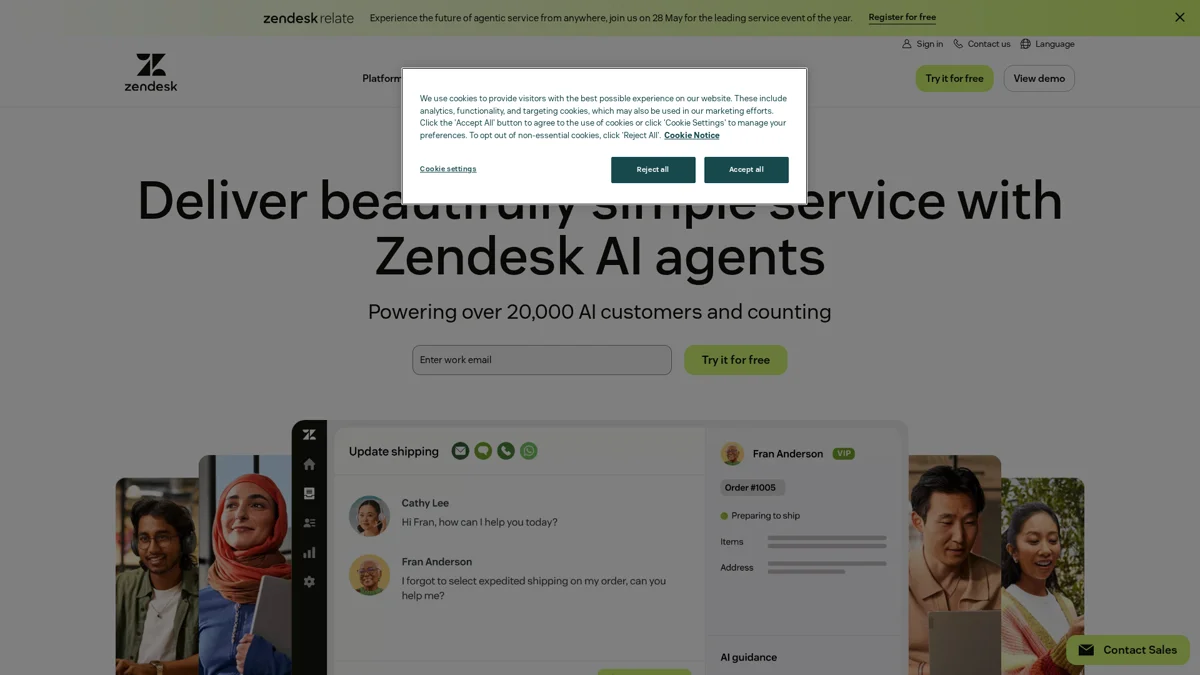
What features does Zendesk offer?
Zendesk's feature set is built around what its target customer base values most — its biggest differentiator versus the alternatives below. It uses a per seat pricing model starting at $19/seat/mo, a different cost structure from a flat-rate alternative like Converge ($49/month for up to 15 agents, all channels and AI included). Features typically split across channel coverage, automation depth, AI tooling, and team management — the grid below shows what matters most for a unified-inbox use case.
Why should you look for Zendesk alternatives?
Teams look for Zendesk alternatives because of structural limitations in its plans and channel coverage — pain points that compound as the team scales past initial setup.
Zendesk's feature depth reflects the more than 19 years since it was founded in 2007: custom ticket workflows with triggers, automations, and macros; Guide knowledge base with AI-powered article suggestions; Talk for voice with IVR and call recording; a marketplace Zendesk sizes at 1,800+ apps, partners and integrations; Zendesk AI with intent detection and automated resolution; workforce management; quality assurance; and community forums. The platform supports enterprise requirements: SOC 2, ISO 27001, CCPA and HIPAA certifications, custom roles, sandbox environments, and data locality.
Social messaging channels (WhatsApp, Instagram, Facebook Messenger) require a Suite plan; the $19/agent/month Support Team plan is email and ticketing only. Telegram needs Sunshine Conversations on Suite Professional and above; Discord and Zalo are not supported. The Copilot add-on costs $50/agent/month on top of the plan rate. The Suite Team plan ($55/agent/month) covers messaging, live chat and a single help center. Teams weighing Zendesk against a multichannel messaging inbox rather than a ticketing suite can read our Trengo vs Zendesk comparison for the channel coverage and real-cost split.
Converge covers nine channels natively — its own chat widget, WhatsApp, Messenger, Instagram, Telegram, Zalo OA, Discord, X (Twitter), and email through your own mailbox over IMAP/SMTP — with AI reply suggestions at $49/month flat. Converge has no ticketing, no public help center, no voice, no app marketplace and no enterprise compliance certifications. It's a focused messaging inbox, not a full customer service platform.
Strengths
- Industry-leading ticketing system with mature workflows
- Marketplace of 1,800+ apps, partners and integrations
- Enterprise-grade security and compliance (HIPAA, SOC2)
- Comprehensive reporting and analytics
Limitations
- Per-agent pricing scales quickly -- add-ons can double the per-seat rate
- AI Copilot is $50/agent/mo extra on top of base plan
- AI resolutions above the plan allowance are billed per resolution at an unpublished rate
- Suite Enterprise has no published price -- it is sales-quoted only
How much does Zendesk cost?
Zendesk pricing starts at $19/seat/mo on a per seat model — but that listed price rarely reflects what teams actually pay. Real cost depends on team size and how the model scales with headcount, channel count and per-channel surcharges, premium-tier gating that surfaces after signup, and add-ons for advanced reporting, premium support, or compliance. The tier breakdown below lists what each plan includes alongside its monthly price.
Zendesk pricing, re-checked against zendesk.com/pricing on 12 September 2026 (per agent, annual billing):
- Support Team: $19/agent/month — email and ticketing only, no messaging or help center
- Suite Team: $55/agent/month — messaging, live chat, one help center, telephony
- Suite Professional: $115/agent/month — SLAs, skills-based routing, community forums
- Suite Enterprise + Copilot: no public price, sales-quoted only
- Copilot: $50/agent/month add-on
Pay monthly rather than annually and those rates become $25, $69 and $149. A 5-agent Professional team: $575/month ($6,900/year). A 10-agent Professional team: $1,150/month ($13,800/year). A 15-agent Professional team with Copilot: ($115+$50) x 15 = $2,475/month ($29,700/year). On top of that, AI resolutions past the plan allowance (10 per agent per month on Professional) are billed per resolution at a rate Zendesk does not publish — so the AI line of a Zendesk quote cannot be modelled from public information at all.
Converge: $49/month ($588/year) for up to 15 agents with AI included. The 15-agent comparison: Zendesk Professional plus Copilot costs 50.5x Converge. Even Suite Team costs 16.8x more per year.
What are the top Zendesk alternatives?
Side-by-side breakdown of features, pricing, and trade-offs.
The top Zendesk alternatives split into two categories serving different team profiles. First, messaging-first unified-inbox platforms built for 3-15 agent teams handling real-time conversations across channels — Converge sits in this category at $49/month flat. Second, traditional ticketing and helpdesk platforms built for larger teams with email-heavy or compliance-heavy workflows. The comparison below covers features, pricing model, and best-fit team type for each.
Converge
Best ValueMessaging-first unified inbox. Flat pricing, all channels included.
Strengths
- $49/month flat rate for up to 15 agents
- Native WhatsApp, Telegram, Messenger, Discord, Zalo
- Unified inbox for real-time conversations
Limitations
- No standalone knowledge base
- Not suited for email-heavy workflows
- No HIPAA/SOC2 compliance

Freshdesk
Cloud-based customer support software by Freshworks
Strengths
- Mature platform with proven reliability at scale
- Email-only teams can pay $19/agent/mo rather than buying messaging they will not use
- Strong automation and workflow capabilities
Limitations
- Two separate product lines priced differently — pick the wrong one and messaging costs a migration, not an upgrade
- Omnichannel messaging requires Omni plans ($29+/agent/mo)
- AI Copilot is $29/agent/mo extra and unavailable at all on Growth or Omni Growth

Intercom
AI-first customer service platform
Strengths
- Fin AI Agent resolves queries autonomously with high accuracy
- Beautiful, modern interface design
- Strong product tour and in-app onboarding features
Limitations
- Per-outcome Fin AI fees ($0.99 each) add up fast at volume
- Premium per-seat pricing plus Pro and Proactive Support add-ons can reach $150+/seat/mo effective
- No Zalo channel in Intercom's channel list

Help Scout
Customer service platform for growing businesses
Strengths
- Clean, intuitive interface loved by support teams
- Excellent email-focused support with collision detection
- Strong knowledge base (Docs) for self-service
Limitations
- WhatsApp only available on Plus tier ($45/user/mo)
- No native Telegram, Discord, or Zalo support
- AI Answers charged per resolution ($0.75 each)

Tidio
Live chat and AI chatbot platform for ecommerce
Strengths
- Excellent Shopify and ecommerce integrations
- Lyro AI chatbot is effective
- Easy setup with no coding required
Limitations
- Conversation-based pricing can get expensive
- Telegram and Discord only on the Plus and Premium plans; no Zalo
- AI features (Lyro) cost extra
How do Zendesk alternatives compare?
Compared head-to-head, Converge ($49/month flat for up to 15 agents) is consistently the cheapest option for messaging-first teams under 15 agents and includes WhatsApp, Telegram, Messenger, Instagram, Discord, and Zalo plus AI tooling in the base subscription. The other major Zendesk alternatives use per-seat models that scale linearly with headcount, compounding past the 3-5 agent threshold. The table below shows starting prices and best-fit profiles for each alternative.
Which Zendesk alternative is best for messaging-first SMBs?
For messaging-first SMBs under 15 agents, Converge is consistently the best Zendesk alternative on the dimensions that matter in practice. It includes native support for WhatsApp, Telegram, Messenger, Instagram, Discord, and Zalo Official Accounts at $49/month flat for up to 15 agents — no per-seat fees, no per-channel add-ons, no premium-tier gating around AI features. The verdict below shows where teams choose Converge and where a different platform fits better.
If your team primarily uses messaging channels (WhatsApp, Telegram, Messenger, Instagram, Discord, Zalo) and wants predictable pricing, Converge is worth considering.
Why teams choose Converge
- $49/month flat rate for up to 15 agents
- Native messaging channels most treat as add-ons
- Unified inbox for real-time conversations
When to choose something else
- Enterprise compliance (HIPAA, SOC2)
- Email/ticket-heavy workflows
- Advanced automation requirements
Choose Zendesk if: You need enterprise-grade ticketing, knowledge base, voice, and a marketplace of 1,800+ apps and integrations. Your team has 20+ agents with compliance requirements (SOC 2, ISO 27001, HIPAA). You need workforce management, quality assurance, and advanced analytics. You want the industry's most established customer service platform.
Choose Converge if: Your team is under 15 people and messaging is your primary channel. You need WhatsApp, Telegram, Discord, Zalo, and Instagram at $49/month flat. You want AI reply suggestions included without per-agent pricing. You prefer a focused messaging inbox that costs $588/year over an enterprise platform that costs $5,000-$30,000/year.
See our breakdown of alternatives to Intercom for more.Frequently Asked Questions
Zendesk pricing is built from four multipliers, not one list price. First, the tier: on Zendesk's pricing page, re-checked 12 September 2026, Support Team is $19/agent/mo, Suite Team $55, Suite Professional $115, and Suite Enterprise + Copilot carries no public price at all. Second, the billing term — those figures are annual rates; month-to-month costs $25, $69 and $149 respectively, roughly 30% more. Third, seat count, because every figure is per agent per month. Fourth, add-ons and usage: Copilot at $50/agent/mo, the Workforce Engagement Bundle at $50/agent/mo, Contact Center at $83/agent/mo, and AI resolutions billed past your plan allowance. Only the first multiplier is on the sticker.
At the annual Suite Professional rate of $115/agent/mo: 5 agents cost $575/month ($6,900/year), 10 agents $1,150/month ($13,800/year), and 15 agents $1,725/month ($20,700/year). Add Copilot at $50/agent/mo and those become $825, $1,650 and $2,475 per month ($9,900, $19,800 and $29,700 per year). On the cheaper Suite Team plan at $55/agent/mo, the same headcounts run $275, $550 and $825 per month. Pay monthly instead of annually and the Professional 5-agent figure rises from $575 to $745. For reference, Converge is $49/month flat for up to 15 agents, so the 15-agent Professional-plus-Copilot scenario is about 50x that.
Partly, and Zendesk says so itself rather than leaving it to rumour. Its pricing FAQ confirms subscriptions run month-to-month, annually, or multi-year, that annual terms are "usually discounted", and that enterprise plans generally require sales engagement — which is where any real negotiation happens. Volume commitments are the main lever: Zendesk's own documentation says buying 100 or more automated resolutions up front ("committed usage") "provides a better per-resolution cost than overage billing", though it publishes neither rate. Zendesk publishes no discount percentage anywhere either, so treat any specific figure you read elsewhere as someone's anecdote, not a rate card. If you qualify, the Zendesk for Startups program is the largest published concession: up to two years free for companies under 250 employees, at or before Series B, and under ten years old.
There is no standalone knowledge base price — it is a plan gate. Support Team ($19/agent/mo) includes no help center at all. The first plan that gets one is Suite Team at $55/agent/mo, which allows a single help center, in one language, nested up to two levels, on standard themes only. Suite Professional at $115/agent/mo raises that to five help centers, 40+ languages, custom and marketplace themes, community forums, a customer portal, and content history. So the practical answer to "what does the knowledge base cost" is the gap between the plan you would otherwise buy and the plan that unlocks the depth you need — for a team wanting multilingual self-service, that is the $55-to-$115 step, or $720/agent/year.
Because Zendesk bills by seat type, not headcount. A full agent seat costs the plan rate. Light agents — people who read tickets and add internal notes but never reply to customers — are included at no charge up to 100 on Suite Professional, with a paid light-agent add-on beyond that. Contributors and end users are free. The catch that surprises finance teams is seat parity: adding one Suite seat adds a seat across every product in the Suite, so you cannot buy eight Support seats and three Talk seats. Usage-metered items also vary per person in effect — automated resolution allowances are granted per agent per month, so a team of ten pools ten allowances regardless of who consumes them.
By outcome, on top of the seat price. AI agents are included on every Suite and Support plan, and Zendesk bills them in automated resolutions: you pay "only for customer requests that were successfully resolved by the AI agent, without any escalation to a human agent". Each plan carries a monthly allowance per agent — 5 on Team, 10 on Professional, 15 on Enterprise, capped at 10,000 per account per year, with light agents excluded from the calculation. Past the allowance you are billed per resolution; Zendesk publishes no per-resolution rate on any public page, only the statement that pre-purchasing 100 or more ("committed usage") costs less per resolution than overage billing. Any specific dollar figure you find for this is someone's quote, not a rate card. Copilot, the agent-facing assistant, is a separate $50/agent/mo add-on and is not the same product. One caveat worth reading before you model any of it: that 5/10/15 table is published in the article describing the platform in place before 18 May 2026. On that date Zendesk introduced resolution tiers, under which assisted escalations and contained resolutions no longer draw down the allowance and only verified resolutions do — so check which platform your account is actually on.
No — both names are stale, which is why pricing for them is impossible to find. Zendesk Connect, the outbound campaign product from the 2017 Outbound.io acquisition, was announced for removal in October 2020 and removed on 31 October 2021. Its capability now lives inside Suite as proactive messages, with no separate SKU: available on every Suite tier, limited to Web Widget and mobile SDK, capped at 140 messages, and not supported on social channels. Zendesk Plus is not a current plan either. It is most often a half-memory of Suite Enterprise Plus, the sales-quoted top tier, or of the pre-2015 legacy "Plus" Support plan that became today's Professional. Two more retired names cause the same dead-end pricing search: Smooch, which Zendesk acquired in 2019 and renamed Sunshine Conversations, and Zendesk Chat, which no longer carries a price of its own — we reconcile both, and the stale rate cards still circulating for them, in Smooch and Zendesk Chat compared.
The top Zendesk alternatives are Freshdesk, Intercom, Help Scout, and Converge. Each offers different strengths: Freshdesk for Mid-sized businesses needing traditional helpdesk, and Converge for messaging-first teams with flat $49/month pricing.
Zendesk starts at $19/seat/mo. For a 5-person team, this costs approximately $575/month. Additional costs may include add-ons, annual billing requirements, and implementation fees.
Zendesk is primarily designed for larger organizations. Small businesses may find the pricing and complexity challenging. Alternatives like Converge offer flat-rate pricing ($49/month for up to 15 agents) better suited for SMBs.
Zendesk's main limitations include: Per-agent pricing scales quickly -- add-ons can double the per-seat rate; AI Copilot is $50/agent/mo extra on top of base plan; AI resolutions above the plan allowance are billed per resolution at an unpublished rate. These factors lead many teams to explore alternatives.
Zendesk at $19/seat/mo is on the higher end compared to alternatives. Freshdesk starts at $19/seat/mo. Converge offers flat $49/month for up to 15 agents, eliminating per-seat scaling.
Ready to try Converge?
$49/month flat. Up to 15 agents. 7-day free trial, no credit card required.
Start Free Trial