
Crisp Alternatives 2026
Crisp is all-in-one business messaging platform with AI support. Best suited for sMBs wanting comprehensive messaging with AI chatbot automation and video support. Known for its magicBrowse co-browsing and Hugo AI agent for automated customer conversations.

Messaging-first unified inbox with flat pricing. WhatsApp, Telegram, Messenger, Discord, Zalo in one place.
Zendesk is customer service software and support ticketing system. Best suited for large enterprises needing comprehensive ticketing with compliance requirements and deep third-party integrations. Known for its industry-leading ticketing system with a marketplace of 1,800+ apps, partners and integrations, and enterprise-grade compliance.
Freshdesk is Freshworks' customer support platform, sold as two separate product lines: standard Freshdesk (email-first ticketing, $19-$89/agent/mo) and Freshdesk Omni (messaging plus ticketing, $29-$119/agent/mo). We re-checked both Freshworks pricing pages on 5 August 2026 — the long-running Free plan is gone from the public rate card and survives only as an in-app, six-month, two-agent Free Program on the standard line. Freddy AI is the standout, but Copilot is a $29/agent/mo add-on on top of whichever plan you pick.
Intercom is an AI-first customer service platform best suited for well-funded SaaS companies that want product tours, in-app messaging, and an AI agent that answers front-line questions. Checked 3 August 2026: the three per-seat plans (Essential, Advanced, Expert) still list at $29, $85, and $132 per seat annually, and Fin AI still bills $0.99 per outcome — so the headline seat price is rarely the real cost. Two things did change this year: the company renamed itself Fin in May 2026, and Salesforce signed a definitive agreement to acquire it in June 2026. The helpdesk product keeps the Intercom name.
Help Scout is customer service platform for growing businesses. Best suited for small-medium businesses wanting a clean, email-focused helpdesk with strong knowledge base and self-service features. Known for its docs knowledge base with AI Answers for self-service resolution.
Crisp is a French customer messaging platform founded in 2015, claiming over 600,000 businesses and 10,000 paying companies on its platform (crisp.chat, 2026). Crisp uses per-workspace pricing — four tiers from Free ($0) to Plus ($295/month) — with fixed seat limits per tier and AI credits billed on a token-consumption model. The platform bundles live chat, a shared inbox, knowledge base, CRM, no-code AI chatbot builder (Hugo AI), MagicBrowse co-browsing, video and audio calls, and 12+ messaging channels into a single product. Channels include chat widget, email, Telegram, Messenger, X (Twitter), Instagram, WhatsApp, SMS, Viber, Phone, and Line. Discord and Zalo are not supported on any tier.
Converge charges $49/month flat for up to 15 team members with all channels included: WhatsApp, Telegram, Discord, Instagram, Zalo, Messenger, X (Twitter), email from your own mailbox over IMAP/SMTP, and an embeddable chat widget with visitor tracking and lead capture. The structural difference is scope versus focus — Crisp bundles CRM, knowledge base, chatbot builder, and co-browsing into one product at higher price points; Converge is a messaging inbox with AI reply suggestions, UTM attribution, and broader channel coverage at a single predictable price.
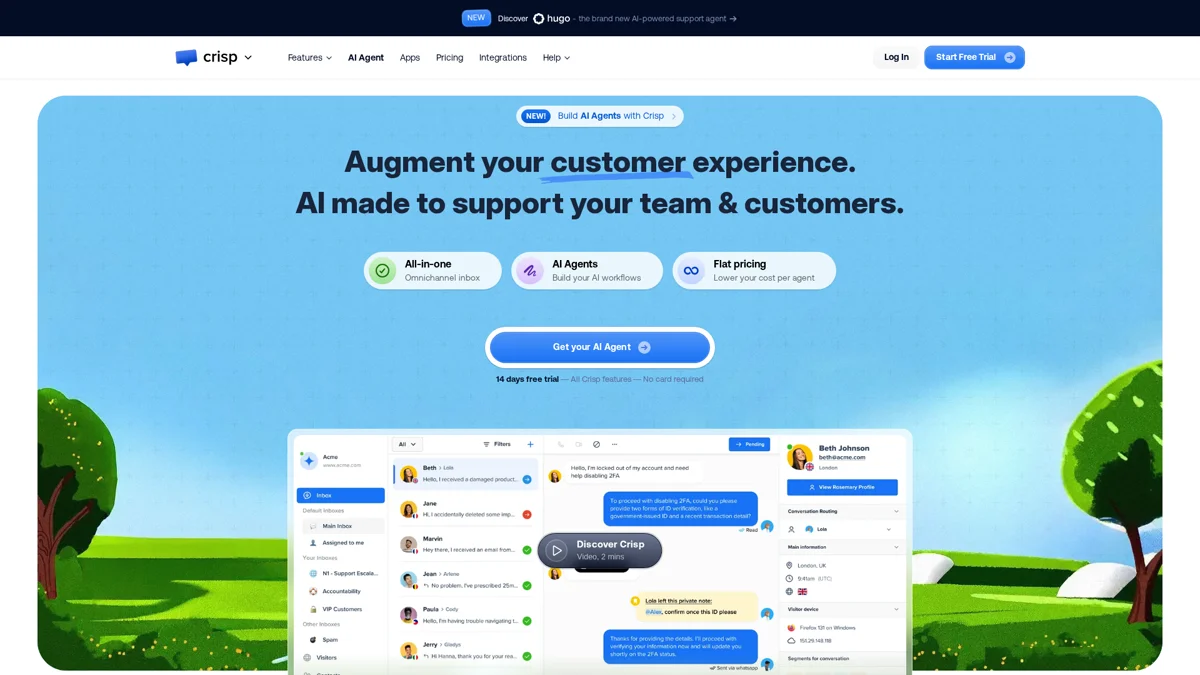
What features does Crisp offer?
Crisp's feature set is built around what its target customer base values most — its biggest differentiator versus the alternatives below. It uses a per workspace pricing model starting at $45/mo, a different cost structure from a flat-rate alternative like Converge ($49/month for up to 15 agents, all channels and AI included). Features typically split across channel coverage, automation depth, AI tooling, and team management — the grid below shows what matters most for a unified-inbox use case.
Why should you look for Crisp alternatives?
Teams look for Crisp alternatives because of structural limitations in its plans and channel coverage — pain points that compound as the team scales past initial setup.
Crisp's feature surface is wide for a mid-market platform. The shared inbox centralizes chat, email, Telegram, Messenger, Instagram, WhatsApp, SMS, Viber, Line, X (Twitter), and phone calls. MagicBrowse lets agents view and navigate a customer's browser in real time without requiring any extension — a co-browsing capability most competitors reserve for enterprise tiers or don't offer at all. The knowledge base builder supports multilingual articles with custom domains, and the CRM includes custom attributes, segmentation, lifecycle tracking, and a customer timeline. The no-code chatbot builder uses a visual flow editor with AI-powered blocks, conditional logic, and webhook integrations. Hugo AI operates as an autonomous agent that handles full conversations, trained on knowledge base content and website data (crisp.chat, 2026).
Channel gating is significant. The Free plan ($0) supports only chat widget and email. The Mini plan ($45/month) adds Telegram, Messenger, and X but still excludes WhatsApp, Instagram, SMS, Viber, Line, and Phone — those require Essentials ($95/month) or above (crisp.chat/pricing, 2026). Ticketing, white-labeling (removing "We run on Crisp" branding), the customer portal, and 100+ third-party integrations (Salesforce, HubSpot, Pipedrive) are locked behind Plus at $295/month. According to a Featurebase analysis (February 2026), most serious teams end up needing the Plus plan once they require ticketing, branding removal, or more than 10 seats.
Converge includes all messaging channels at $49/month — WhatsApp, Telegram, Discord, Instagram, Zalo, Messenger, X (Twitter) and email — with no tier gating. AI reply suggestions with configurable tone (professional, friendly, casual) and quick reply matching are included without credit limits; teams can bring their own API key for AI features. The chat widget provides visitor tracking, UTM attribution, session management, FAQ self-service, suggested messages, and CSAT collection. Converge does not include CRM, knowledge base, co-browsing, video calls, or an autonomous chatbot builder — it is a focused messaging inbox with lead capture and AI-assisted replies rather than a bundled platform.
What is the best Crisp alternative for small teams?
For a small team, the best Crisp alternative is the one that removes the two limits teams hit first on Crisp: the 10-seat Essentials cap and the metered Hugo AI credits. Crisp Essentials ($95/month per workspace) covers 10 seats and ~450 AI conversations before automation pauses; crossing either threshold forces the $295/month Plus tier. Flat-rate inboxes sidestep both — Converge runs $49/month for up to 15 agents with uncapped AI suggestions and native Discord and Zalo. Tidio suits teams that want a generous free tier, Chatwoot fits teams comfortable self-hosting an open-source stack, and HelpCrunch appeals to those who want email marketing bundled with chat. If EU hosting and chat-to-video escalation are why you picked Crisp, Userlike (now sold as Lime Connect) is the German-built option; our Userlike vs Converge comparison prices its new seat-minimum plans for a five-agent team. Match the pick to which Crisp ceiling actually blocks you — seats, AI volume, channel gaps, or branding removal.
Strengths
- Broad feature set covering chat, video, CRM, and knowledge base
- Hugo AI agent for automated conversations
- MagicBrowse for co-browsing and video support
- Generous free tier for testing
Limitations
- AI credits cover about 90-450 automated conversations/mo on Mini and Essentials
- Ticketing and customer portal locked behind $295/mo Plus plan
- No Discord or Zalo support
- Big price jump from Essentials ($95) to Plus ($295)
How much does Crisp cost?
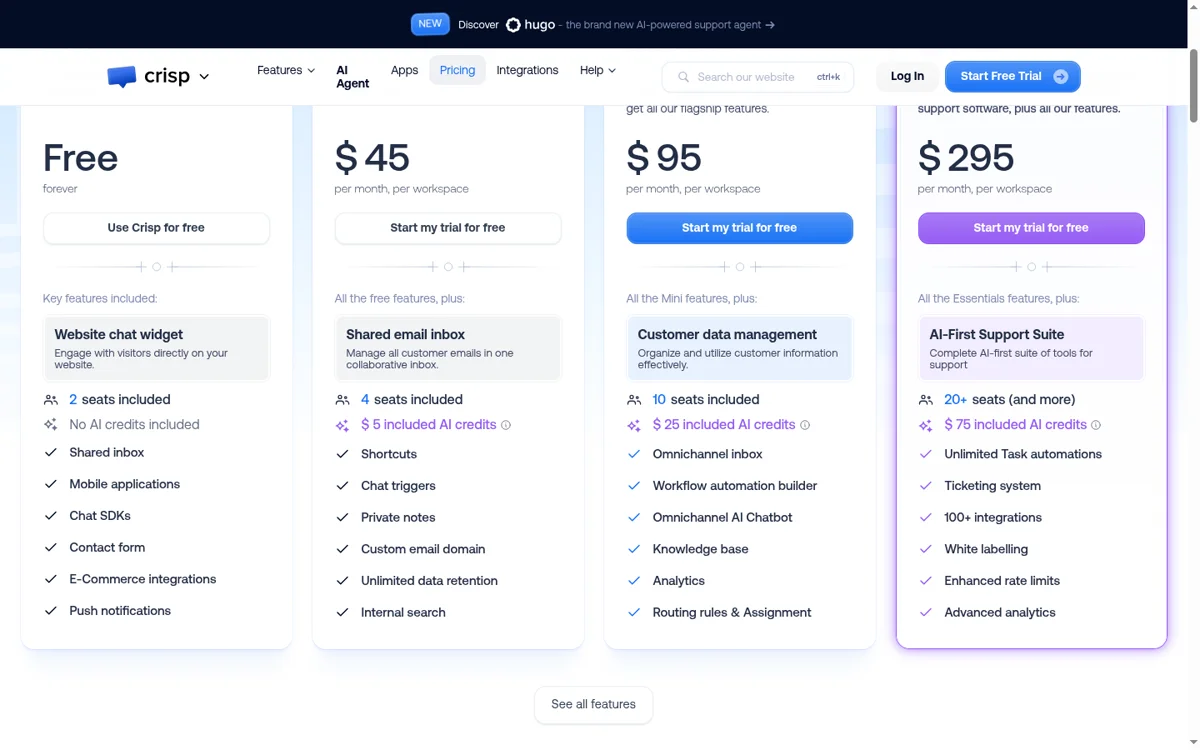
Crisp pricing starts at $45/mo on a per workspace model — but that listed price rarely reflects what teams actually pay. Real cost depends on team size and how the model scales with headcount, channel count and per-channel surcharges, premium-tier gating that surfaces after signup, and add-ons for advanced reporting, premium support, or compliance. The tier breakdown below lists what each plan includes alongside its monthly price.
Crisp pricing as of March 2026 (per workspace, billed monthly) from crisp.chat/pricing:
- Free: $0/month — 2 seats, 100 customer profiles, chat widget and email only, no AI credits
- Mini: $45/month — 4 seats, 5,000 profiles, $5 AI credits (~90 automated conversations/month), adds Telegram, Messenger, X, canned responses, chat triggers
- Essentials: $95/month — 10 seats, 50,000 profiles, $25 AI credits (~450 automated conversations/month), adds WhatsApp, Instagram, SMS, Viber, Line, Phone, knowledge base, workflow builder, analytics, routing rules
- Plus: $295/month — 20+ seats, 200,000 profiles, $75 AI credits (~1,350 automated conversations/month), adds ticketing, customer portal, white-labeling, 100+ integrations, advanced analytics. Extra seats $10/agent/month
Hugo AI runs on a token-credit system. When the included monthly credits run out, Hugo stops responding unless Pay-As-You-Go is enabled in AI Agent billing settings, at roughly $0.05 per conversation (help.crisp.chat, 2026). The Essentials plan's $25 allowance covers approximately 450 conversations — a team handling 25 conversations per day exhausts this in under three weeks. Additional seats beyond the included count are available only on the Plus plan at $10/agent/month; teams on Mini or Essentials cannot add agents beyond the 4- or 10-seat cap. A subtler gate sits inside the inbox itself: sub-inboxes (the dedicated folders that keep a busy team's conversations organized) are capped at 0 on Free and Mini, 2 on Essentials, and 5 on Plus (verified against crisp.chat/pricing, June 2026) — so a team that wants to separate sales, billing, and support queues hits a structural ceiling well before it runs out of seats.
Converge: $49/month flat for up to 15 team members, all channels included, AI reply suggestions with no credit system, 7-day free trial with no credit card required. A 10-person team on Crisp Essentials pays $95/month with AI capped at ~450 conversations. The same team on Converge pays $49/month with uncapped AI suggestions — saving $552/year. A 15-person team requires Crisp Plus at $295/month (since Essentials caps at 10 seats); that is 6× the cost of Converge for the same headcount. Crisp does offer a 20% discount for 3+ workspaces under one account and a 30% lifetime startup discount for companies under $1M in funding and less than 3 years old (crisp.chat FAQ, 2026).
What are the top Crisp alternatives?
Side-by-side breakdown of features, pricing, and trade-offs.
The top Crisp alternatives split into two categories serving different team profiles. First, messaging-first unified-inbox platforms built for 3-15 agent teams handling real-time conversations across channels — Converge sits in this category at $49/month flat. Second, traditional ticketing and helpdesk platforms built for larger teams with email-heavy or compliance-heavy workflows. The comparison below covers features, pricing model, and best-fit team type for each.
Converge
Best ValueMessaging-first unified inbox. Flat pricing, all channels included.
Strengths
- $49/month flat rate for up to 15 agents
- Native WhatsApp, Telegram, Messenger, Discord, Zalo
- Unified inbox for real-time conversations
Limitations
- No standalone knowledge base
- Not suited for email-heavy workflows
- No HIPAA/SOC2 compliance

Zendesk
Customer service software and support ticketing system
Strengths
- Industry-leading ticketing system with mature workflows
- Marketplace of 1,800+ apps, partners and integrations
- Enterprise-grade security and compliance (HIPAA, SOC2)
Limitations
- Per-agent pricing scales quickly -- add-ons can double the per-seat rate
- AI Copilot is $50/agent/mo extra on top of base plan
- AI resolutions above the plan allowance are billed per resolution at an unpublished rate

Freshdesk
Cloud-based customer support software by Freshworks
Strengths
- Mature platform with proven reliability at scale
- Email-only teams can pay $19/agent/mo rather than buying messaging they will not use
- Strong automation and workflow capabilities
Limitations
- Two separate product lines priced differently — pick the wrong one and messaging costs a migration, not an upgrade
- Omnichannel messaging requires Omni plans ($29+/agent/mo)
- AI Copilot is $29/agent/mo extra and unavailable at all on Growth or Omni Growth

Intercom
AI-first customer service platform
Strengths
- Fin AI Agent resolves queries autonomously with high accuracy
- Beautiful, modern interface design
- Strong product tour and in-app onboarding features
Limitations
- Per-outcome Fin AI fees ($0.99 each) add up fast at volume
- Premium per-seat pricing plus Pro and Proactive Support add-ons can reach $150+/seat/mo effective
- No Zalo channel in Intercom's channel list

Help Scout
Customer service platform for growing businesses
Strengths
- Clean, intuitive interface loved by support teams
- Excellent email-focused support with collision detection
- Strong knowledge base (Docs) for self-service
Limitations
- WhatsApp only available on Plus tier ($45/user/mo)
- No native Telegram, Discord, or Zalo support
- AI Answers charged per resolution ($0.75 each)
How do Crisp alternatives compare?
Compared head-to-head, Converge ($49/month flat for up to 15 agents) is consistently the cheapest option for messaging-first teams under 15 agents and includes WhatsApp, Telegram, Messenger, Instagram, Discord, and Zalo plus AI tooling in the base subscription. The other major Crisp alternatives use per-seat models that scale linearly with headcount, compounding past the 3-5 agent threshold. The table below shows starting prices and best-fit profiles for each alternative.
Which Crisp alternative is best for messaging-first SMBs?
For messaging-first SMBs under 15 agents, Converge is consistently the best Crisp alternative on the dimensions that matter in practice. It includes native support for WhatsApp, Telegram, Messenger, Instagram, Discord, and Zalo Official Accounts at $49/month flat for up to 15 agents — no per-seat fees, no per-channel add-ons, no premium-tier gating around AI features. The verdict below shows where teams choose Converge and where a different platform fits better.
If your team primarily uses messaging channels (WhatsApp, Telegram, Messenger, Instagram, Discord, Zalo) and wants predictable pricing, Converge is worth considering.
Why teams choose Converge
- $49/month flat rate for up to 15 agents
- Native messaging channels most treat as add-ons
- Unified inbox for real-time conversations
When to choose something else
- Enterprise compliance (HIPAA, SOC2)
- Email/ticket-heavy workflows
- Advanced automation requirements
Choose Crisp if:
- You need CRM, knowledge base, chatbot builder, and co-browsing in a single subscription
- MagicBrowse co-browsing is required for your support workflow (screen sharing without browser extensions)
- You want an autonomous AI chatbot (Hugo AI) that handles full conversations without agent involvement
- Your team needs a visual no-code workflow builder for multi-channel chatbot automation
- You operate in regulated industries where Crisp's EU-hosted infrastructure and DPA matter
Choose Converge if:
- You need native Discord or Zalo channel support (Crisp does not offer either)
- You want all channels and AI reply suggestions at $49/month flat — no credit caps, no per-workspace scaling
- Your team is 5–15 agents, where Crisp's tier structure forces $95–$295/month commitments
- You need visitor tracking with UTM attribution, beacon tracking, and lead capture in your chat widget
- You prefer a focused messaging inbox over a bundled CRM + knowledge base + chatbot platform
- Predictable pricing matters — no AI credit overages, no seat add-on costs, no workspace multiplication
Frequently Asked Questions
For small teams of 5–15 agents, the best Crisp alternative is whichever one removes the two limits teams hit first: the 10-seat Essentials cap and the per-conversation AI credit meter. Crisp's Essentials plan ($95/month, per workspace) covers 10 seats with ~450 AI conversations before Hugo AI stops responding; growing past 10 agents forces the $295/month Plus plan. Flat-rate platforms avoid both ceilings — Converge, for example, is $49/month for up to 15 agents with AI reply suggestions and no conversation caps, and adds Discord and Zalo (which Crisp supports on no tier). Tidio, Chatwoot, and HelpCrunch are other common picks depending on whether you weight free tiers, open-source self-hosting, or built-in CRM.
Yes. Crisp gates meaningful AI behind a credit system — $25/month of Hugo AI credits on the $95 Essentials plan (about 450 conversations) and $75 on the $295 Plus plan, after which responses pause unless you enable pay-as-you-go at roughly $0.05 per conversation. Cheaper alternatives bundle AI without the meter: Converge includes AI reply suggestions with configurable tone at $49/month flat for up to 15 agents and no per-conversation cap, and Tidio's Lyro AI starts lower per seat but charges per AI conversation above its included quota. The key difference is metered (Crisp) versus included (flat-rate) AI — for steady support volume, an uncapped plan is usually cheaper once you cross a few hundred AI conversations a month.
Crisp does not offer a native conversation export from the dashboard — as of March 2026, conversation data cannot be exported through the UI. To retrieve conversation history, use the REST API V1: GET /v1/website/{website_id}/conversations with pagination, then fetch individual messages per conversation. Generate an API token from Settings > Workspace Settings > Advanced Configuration. Two token types are available: Website Token (10,000 requests/day) and Plugin Token (5,000 requests/day, configurable). Official API libraries exist for Node.js (crisp-api), Python, PHP, Go, and Ruby. A community tool — crisp-export-chat-node on GitHub by dinistavares — is built specifically for bulk conversation export. For no-code export, Briskport syncs Crisp data to data warehouses. You can request higher rate limits from Crisp support for large exports.
In the Crisp dashboard, go to the Contacts tab, then click Action > Export contact profiles in the upper right corner. Crisp processes the export and sends an email notification when the CSV is ready. The export includes names, email addresses, phone numbers, and custom data fields. There's a limit of 200,000 contacts per export — contact Crisp support if you need more. Important: the CRM and contact export feature requires the Essentials plan ($95/mo) or higher. Free and Mini plan users don't have access to CRM export.
Yes. Crisp's REST API V1 at api.crisp.chat provides endpoints for conversations, contacts, helpdesk articles, and more. Authentication uses two token types: Website Token (generated from Settings > Workspace Settings > Advanced Configuration, 10,000 requests/day) and Plugin Token (5,000 requests/day, configurable rate). Official client libraries are available in five languages: Node.js (crisp-api), Python, PHP, Go, and Ruby. The API covers conversation retrieval, contact management, and helpdesk content — though some data like Triggers, Workflows, and Hugo AI training data is not accessible via the API.
The switch itself is free — most platforms offer free trials. The main costs are time (1–3 days for a typical migration) and any overlap period running both platforms. If you're on Crisp Essentials ($95/mo) with 10 seats, switching to a flat-rate platform like Converge at $49/month saves $552/year with room for up to 15 agents. Contact export is available via CSV (Essentials+ required), conversations require the REST API, and channel reconnections (WhatsApp, Telegram, Messenger) take 2–5 minutes each.
The top Crisp alternatives are Zendesk, Freshdesk, Intercom, and Converge. Each offers different strengths: Zendesk for Large enterprises needing comprehensive ticketing, and Converge for messaging-first teams with flat $49/month pricing.
Crisp starts at $45/mo. Additional costs may include add-ons, annual billing requirements, and implementation fees.
Crisp can work for small businesses. Alternatives like Converge offer flat-rate pricing ($49/month for up to 15 agents) better suited for SMBs.
Crisp's main limitations include: AI credits cover about 90-450 automated conversations/mo on Mini and Essentials; Ticketing and customer portal locked behind $295/mo Plus plan; No Discord or Zalo support. These factors lead many teams to explore alternatives.
Crisp at $45/mo is on the higher end compared to alternatives. Zendesk starts at $19/seat/mo. Converge offers flat $49/month for up to 15 agents, eliminating per-seat scaling.
Ready to try Converge?
$49/month flat. Up to 15 agents. 7-day free trial, no credit card required.
Start Free Trial