
Respond.io Alternatives 2026
Respond.io is aI-powered omnichannel messaging platform for customer engagement. Best suited for sales-oriented teams needing AI agents, broadcast messaging, and CRM integrations for lead-to-customer conversion. Known for its aI Agents that handle complex conversations, qualify leads, and trigger workflow automations without human intervention.

Messaging-first unified inbox with flat pricing. WhatsApp, Telegram, Messenger, Discord, Zalo in one place.
Zendesk is customer service software and support ticketing system. Best suited for large enterprises needing comprehensive ticketing with compliance requirements and deep third-party integrations. Known for its industry-leading ticketing system with a marketplace of 1,800+ apps, partners and integrations, and enterprise-grade compliance.
Freshdesk is Freshworks' customer support platform, sold as two separate product lines: standard Freshdesk (email-first ticketing, $19-$89/agent/mo) and Freshdesk Omni (messaging plus ticketing, $29-$119/agent/mo). We re-checked both Freshworks pricing pages on 5 August 2026 — the long-running Free plan is gone from the public rate card and survives only as an in-app, six-month, two-agent Free Program on the standard line. Freddy AI is the standout, but Copilot is a $29/agent/mo add-on on top of whichever plan you pick.
Intercom is an AI-first customer service platform best suited for well-funded SaaS companies that want product tours, in-app messaging, and an AI agent that answers front-line questions. Checked 3 August 2026: the three per-seat plans (Essential, Advanced, Expert) still list at $29, $85, and $132 per seat annually, and Fin AI still bills $0.99 per outcome — so the headline seat price is rarely the real cost. Two things did change this year: the company renamed itself Fin in May 2026, and Salesforce signed a definitive agreement to acquire it in June 2026. The helpdesk product keeps the Intercom name.
Help Scout is customer service platform for growing businesses. Best suited for small-medium businesses wanting a clean, email-focused helpdesk with strong knowledge base and self-service features. Known for its docs knowledge base with AI Answers for self-service resolution.
Most people comparing respond.io alternatives are not shopping for features. They are trying to make a bill stop moving. Respond.io prices on Monthly Active Contacts rather than seats, and the number that matters is not on the pricing card: $159 is the Growth price at the 1,000-contact tier only. The pricing page carries a contact selector — 1,000 / 2,500 / 5,000 / 10,000 / more than 10,000 — and moving it up reprices the plan itself (respond.io pricing page, checked 22 August 2026). Overage is the second layer on top of that, not the whole story, which is how most comparisons of respond.io get it wrong.
This page is built to answer three questions a feature table cannot: what respond.io actually costs once both of its meters are running, what specifically breaks when you leave, and who should not leave at all. Respond.io is a capable platform and there is a real profile of team that should stay on it — that profile is spelled out at the end rather than buried. Converge appears here as one option among several, at $49/month flat for up to 15 agents with no contact meter.
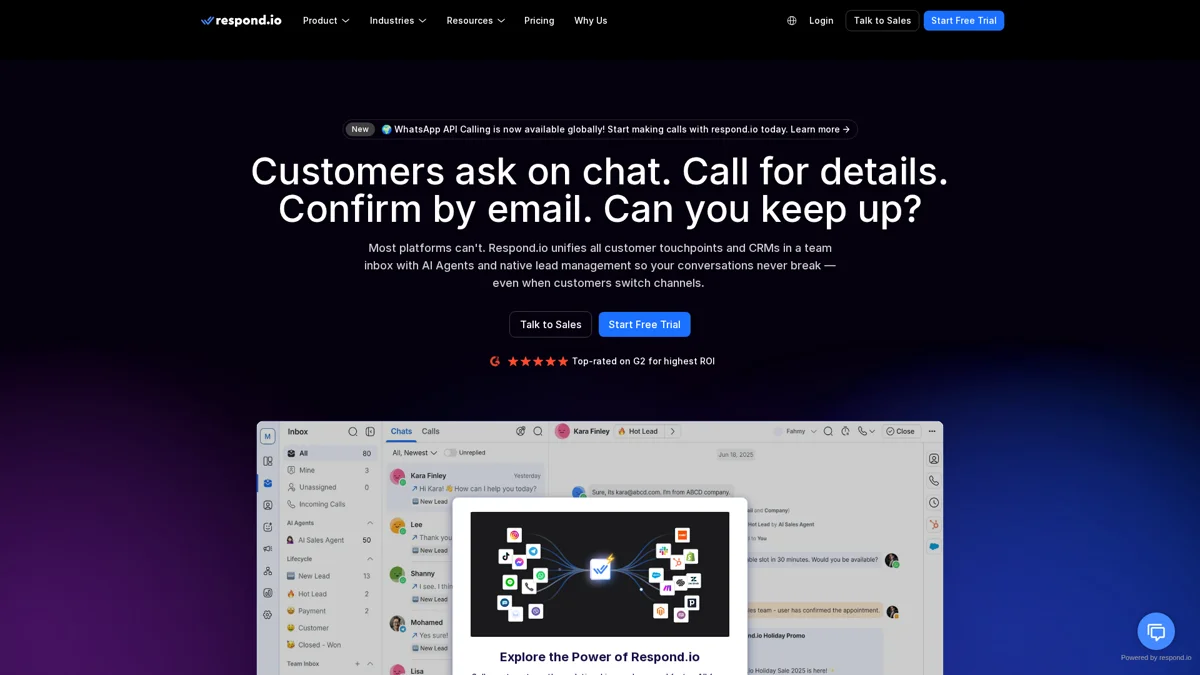
What features does Respond.io offer?
Respond.io's feature set is built around what its target customer base values most — its biggest differentiator versus the alternatives below. It uses a usage-based pricing model starting at $79/mo, a different cost structure from a flat-rate alternative like Converge ($49/month for up to 15 agents, all channels and AI included). Features typically split across channel coverage, automation depth, AI tooling, and team management — the grid below shows what matters most for a unified-inbox use case.
Why should you look for Respond.io alternatives?
Teams look for Respond.io alternatives because of structural limitations in its plans and channel coverage — pain points that compound as the team scales past initial setup.
What exactly counts as a Monthly Active Contact?
A contact who sends or receives a message, or makes or receives a call, during the billing month — and an outbound message that fails to send still counts (respond.io Billing & Usage documentation, checked 22 August 2026). Broadcasts are the single exception. That definition is the part worth pausing on, because it decides your bill. It is not "conversations you had". A contact who ignores you counts. A wrong number counts. A message that bounces counts. The meter resets at the start of each billing cycle, so a one-off list-cleaning push lands entirely in one month.
This is why the honest test before you switch is not a feature audit. Open Billing & Usage, click Details under MAC, and read your last three billing periods. If your contact count is flat, respond.io's model is working for you and the rest of this page is academic. If it steps up every month, you are on a meter that rewards a quiet business — and no alternative will fix that if the thing driving it is genuine growth in people you need to reach.
The second meter most comparisons miss
AI Credits are a full second usage meter, and they are the one teams do not see coming. Every AI action draws from a monthly pool: AI Assist, AI Translate and chat summaries cost 1 credit each, an AI Agent response costs 2–5 credits, call transcription runs ~2 credits per minute, and a Voice AI Agent burns roughly 70 credits per minute (respond.io AI Credits documentation, checked 22 August 2026). The allowance scales with your contact tier — 10x on Growth, 20x on Advanced, 40x on Enterprise — so Growth at 1,000 contacts gets 10,000 credits.
Run the voice arithmetic before trusting the "AI is included" headline: at ~70 credits per minute, a Growth plan's entire 10,000-credit monthly allowance is roughly two and a half hours of Voice AI Agent time. Past that, on-demand bills automatically at $15 per 1,000 credits, rounded up per block — exceed by a single credit and you are charged the full $15. There is a hard cap at 200% of the allowance, which is genuinely a consumer protection: the worst case on a 10,000-credit plan is $150, then AI pauses until the cycle resets. Text-only AI use rarely troubles the pool. Voice is a different product with a different cost shape wearing the same "included" label.
Which channels does respond.io actually cover?
Respond.io has the broader channel catalog: WhatsApp, Telegram, LINE, WeChat, Viber, Instagram, Messenger, TikTok, SMS via Twilio/MessageBird/Vonage, plus HubSpot and Salesforce panels, Zapier, Make, n8n and a Developer API on Growth and above. Flat-rate support inboxes generally do not match that breadth — no LINE, no WeChat, no Viber, no native CRM sidebar. The two channels respond.io does not support at any tier are Discord and Zalo, which is a genuine gap for gaming and developer communities and for teams selling into Vietnam, and irrelevant to everyone else. If your customers are on LINE or WeChat, respond.io is simply the correct tool and switching would cost you a channel.
Strengths
- Powerful AI Agents for automated customer conversations
- Visual workflow automation builder with conditional logic
- Strong broadcast messaging for marketing campaigns
- Good CRM integrations (HubSpot, Salesforce, Zapier, Make)
Limitations
- Two usage meters run at once — Monthly Active Contacts and AI Credits — and both climb with engagement
- The advertised $159 Growth price is the 1,000-contact tier only; the plan reprices as you move up the contact selector
- A failed outbound message still burns a Monthly Active Contact
- WhatsApp per-conversation fees add to base cost
How much does Respond.io cost?
Respond.io pricing starts at $79/mo on a usage-based model — but that listed price rarely reflects what teams actually pay. Real cost depends on team size and how the model scales with headcount, channel count and per-channel surcharges, premium-tier gating that surfaces after signup, and add-ons for advanced reporting, premium support, or compliance. The tier breakdown below lists what each plan includes alongside its monthly price.
Respond.io pricing at the 1,000-contact tier, annual billing (monthly billing runs ~25% higher — $99/$199/$349), verified against respond.io's pricing page on 22 August 2026:
- Starter: $79/month — 5 seats, unlimited monthly active contacts, a fixed 5,000 AI Credits, but no workflows, no broadcasts, no AI Agents, no Developer API
- Growth: $159/month — 10 seats, 1,000 contacts, AI Credits at 10x the contact tier, adds workflows, broadcasts, AI Agents, Zapier/Make/n8n and the Developer API
- Advanced: $279/month — 10 seats, 1,000 contacts, AI Credits at 20x, multiple workspaces, custom channels, SSO, webhooks, phone/email masking
- Enterprise: custom — unlimited users, higher workspace and API rate limits
Read those four numbers as floors, not prices. The contact selector at the top of the pricing page reprices every self-serve plan as you move up through 2,500, 5,000 and 10,000 contacts; the $79/$159/$279 figures are what the page displays at the lowest setting. Any comparison that quotes "$159/month" without naming the contact tier — including, previously, this page — is quoting a floor.
Two changes worth flagging if you priced respond.io earlier in 2026. Advanced no longer offers self-serve signup: Starter and Growth show "Start Free Trial", while Advanced and Enterprise show "Talk to Sales", so the top self-serve tier is now sales-gated. And the trial has a failure mode that is easy to miss — it ends early if you hit 100% of its MAC limit (respond.io Billing & Usage documentation, 22 August 2026), so a team that stress-tests the platform with a contact import can end its own evaluation in two days.
Overage sits on top of the tier price: $12 per 100 contacts on Growth, $15 per 100 on Advanced, billed at cycle end. Extra seats are +$12 (Starter), +$20 (Growth), +$24 (Advanced) each per month. Respond.io's own documentation calls on-demand "intended for temporary, seasonal usage spikes" and says a permanent increase should be a tier upgrade — so persistent overage means you are on the wrong tier, not getting a bargain. Meta's WhatsApp conversation fees apply on top of all of it, at no respond.io markup.
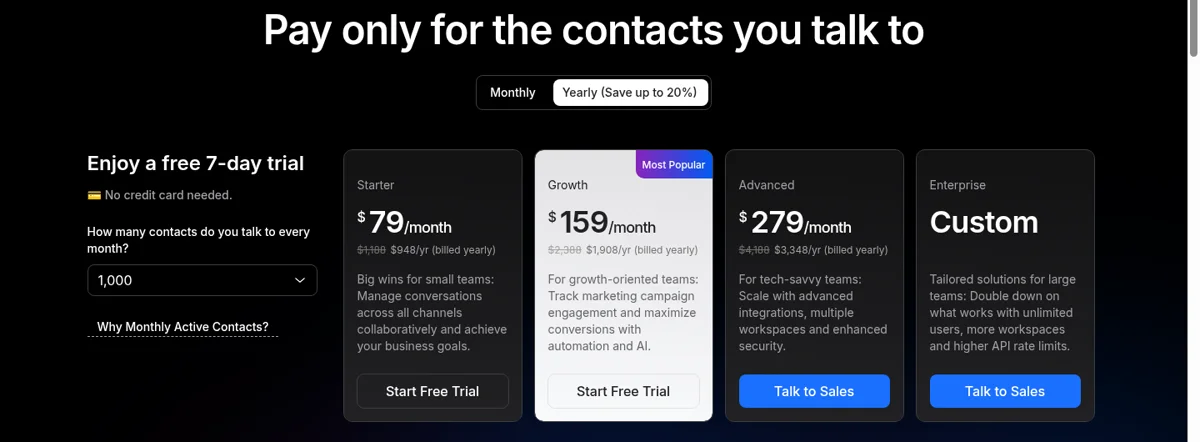
Two-panel screenshot of respond.io's pricing page contact selector, captured 2026-08-22, evidencing that the advertised price is a floor. Left panel: selector set to 1,000 contacts showing Starter $79 / Growth $159 / Advanced $279. Right panel: same page with the selector moved to 5,000 contacts, showing the repriced plan cards. Keep both panels at identical viewport width and crop to the plan-card row plus the selector control so the price delta is the only visible difference.
Does respond.io work out cheaper than a flat-rate inbox?
It depends entirely on whether your contact count is stable, and the crossover is worth calculating rather than assuming. Respond.io bills on contacts; a flat-rate inbox like Converge bills $49/month for up to 15 agents with no contact meter. A team with 12 agents and a small, steady contact base can genuinely land close on price, and if that team needs LINE, broadcasts or the workflow builder, respond.io is the better buy outright — those are real capabilities a support-focused inbox does not have.
The gap opens on two specific shapes. First, seat-heavy teams: respond.io's included 10 seats on Growth means agents 11 through 15 cost +$20/month each, so a 15-agent team adds $100/month on top of the tier price, while the same headcount sits inside a flat rate. Second, growing contact volume, where the tier price and the overage line move together in the same direction. What a flat rate buys is not always a lower number — it is a number that does not change when a campaign works. That predictability is worth most to teams whose contact count is climbing, and worth nearly nothing to teams whose contact count is flat.
What are the top Respond.io alternatives?
Side-by-side breakdown of features, pricing, and trade-offs.
The top Respond.io alternatives split into two categories serving different team profiles. First, messaging-first unified-inbox platforms built for 3-15 agent teams handling real-time conversations across channels — Converge sits in this category at $49/month flat. Second, traditional ticketing and helpdesk platforms built for larger teams with email-heavy or compliance-heavy workflows. The comparison below covers features, pricing model, and best-fit team type for each.
Converge
Best ValueMessaging-first unified inbox. Flat pricing, all channels included.
Strengths
- $49/month flat rate for up to 15 agents
- Native WhatsApp, Telegram, Messenger, Discord, Zalo
- Unified inbox for real-time conversations
Limitations
- No standalone knowledge base
- Not suited for email-heavy workflows
- No HIPAA/SOC2 compliance

Zendesk
Customer service software and support ticketing system
Strengths
- Industry-leading ticketing system with mature workflows
- Marketplace of 1,800+ apps, partners and integrations
- Enterprise-grade security and compliance (HIPAA, SOC2)
Limitations
- Per-agent pricing scales quickly -- add-ons can double the per-seat rate
- AI Copilot is $50/agent/mo extra on top of base plan
- AI resolutions above the plan allowance are billed per resolution at an unpublished rate

Freshdesk
Cloud-based customer support software by Freshworks
Strengths
- Mature platform with proven reliability at scale
- Email-only teams can pay $19/agent/mo rather than buying messaging they will not use
- Strong automation and workflow capabilities
Limitations
- Two separate product lines priced differently — pick the wrong one and messaging costs a migration, not an upgrade
- Omnichannel messaging requires Omni plans ($29+/agent/mo)
- AI Copilot is $29/agent/mo extra and unavailable at all on Growth or Omni Growth

Intercom
AI-first customer service platform
Strengths
- Fin AI Agent resolves queries autonomously with high accuracy
- Beautiful, modern interface design
- Strong product tour and in-app onboarding features
Limitations
- Per-outcome Fin AI fees ($0.99 each) add up fast at volume
- Premium per-seat pricing plus Pro and Proactive Support add-ons can reach $150+/seat/mo effective
- No Zalo channel in Intercom's channel list

Help Scout
Customer service platform for growing businesses
Strengths
- Clean, intuitive interface loved by support teams
- Excellent email-focused support with collision detection
- Strong knowledge base (Docs) for self-service
Limitations
- WhatsApp only available on Plus tier ($45/user/mo)
- No native Telegram, Discord, or Zalo support
- AI Answers charged per resolution ($0.75 each)
How do Respond.io alternatives compare?
Compared head-to-head, Converge ($49/month flat for up to 15 agents) is consistently the cheapest option for messaging-first teams under 15 agents and includes WhatsApp, Telegram, Messenger, Instagram, Discord, and Zalo plus AI tooling in the base subscription. The other major Respond.io alternatives use per-seat models that scale linearly with headcount, compounding past the 3-5 agent threshold. The table below shows starting prices and best-fit profiles for each alternative.
Which Respond.io alternative is best for messaging-first SMBs?
For messaging-first SMBs under 15 agents, Converge is consistently the best Respond.io alternative on the dimensions that matter in practice. It includes native support for WhatsApp, Telegram, Messenger, Instagram, Discord, and Zalo Official Accounts at $49/month flat for up to 15 agents — no per-seat fees, no per-channel add-ons, no premium-tier gating around AI features. The verdict below shows where teams choose Converge and where a different platform fits better.
If your team primarily uses messaging channels (WhatsApp, Telegram, Messenger, Instagram, Discord, Zalo) and wants predictable pricing, Converge is worth considering.
Why teams choose Converge
- $49/month flat rate for up to 15 agents
- Native messaging channels most treat as add-ons
- Unified inbox for real-time conversations
When to choose something else
- Enterprise compliance (HIPAA, SOC2)
- Email/ticket-heavy workflows
- Advanced automation requirements
What actually breaks when you leave respond.io
Export first, and know its limits before you plan the switch. Under Workspace SettingsData settingsData export (Owners and Managers only) you can pull Contacts, Conversations, Messages and Failed Messages. Three constraints shape the timeline: each request covers a maximum 365-day range, only one export job runs at a time per workspace, and the finished file expires after 7 days. A job running past 15 minutes is dismissed, with a 30-minute cooldown before you retry. Multi-year history therefore means several sequential requests, not one — start the exports before you give notice, not after.
Two details bite people. Conversation exports are selected by open time, not resolution time, so a thread opened in December and resolved in January lands in the December file — date-bounded exports will look like they are missing data when they are not. And respond.io prepends an apostrophe before =, +, -, @, tabs, semicolons and pipes as formula-injection protection; those markers must be stripped before the CSV loads cleanly anywhere else (respond.io Data Export documentation, 22 August 2026).
What does not come out at all: workflow automations, AI Agent configurations, broadcast templates, Growth Widget settings and custom channel setups. There is no export for any of them. Screenshot your workflow canvas and copy your AI Agent guidance text by hand before you cancel, because a canceled organization is flagged for deletion after 30 days and incoming messages stop being stored during cancellation. WhatsApp is the one channel with real switching cost: your number is registered to respond.io as its Business Solution Provider, so moving it means disabling 2FA, disconnecting, and re-registering through the new platform — verified name and approved templates carry over via Meta, but there is a short window where inbound messages reach neither inbox. Cut over at your quietest hour. Telegram is instant with the same BotFather token; Messenger and Instagram are a two-minute Meta OAuth each.
Who should stay on respond.io
Stay if any of these is true. Your customers are on LINE, WeChat or Viber — no flat-rate messaging inbox covers these, and switching costs you the channel outright. You depend on WhatsApp broadcast campaigns, which is a marketing capability support-focused inboxes deliberately do not include. Your automation genuinely needs branching logic that purpose-built auto-reply and routing rules cannot express. Or you checked Billing & Usage and your contact count has been flat for three cycles, in which case the meter is not costing you anything and a migration would be work without payoff.
Look at alternatives if your MAC graph steps up every month, if you are paying for seats 11+ on top of a tier that already reprices with growth, if you need Discord or Zalo, or if your use is support rather than outbound sales — respond.io's centre of gravity is lead conversion, and a team using it purely as a support inbox is paying for a sales engine it never runs. Converge fits the narrow case: 3–15 agent support teams on WhatsApp, Telegram, Instagram, Messenger, Discord or Zalo who want the bill to stop moving, at $49/month flat for up to 15 agents. It is not the right answer for LINE, for broadcasts, or for enterprise compliance requirements.
Frequently Asked Questions
Starter costs $79/month on annual billing or $99/month monthly, and includes 5 user seats plus unlimited monthly active contacts and a fixed 5,000 AI Credits that do not scale with usage (respond.io pricing page, 22 August 2026). The unlimited-contacts headline is real but narrower than it sounds: Starter excludes workflow automation, broadcast messaging and AI Agents, so you cannot reach those contacts proactively. Adding any of them means Growth at $159/month — which is also the plan that introduces the 1,000-contact meter and $12-per-100 overage. The upgrade that unlocks automation is the same upgrade that starts metering your contacts.
Respond.io charges Meta's WhatsApp per-conversation fees on top of every plan. There is no separate WhatsApp add-on fee — but conversation costs vary by country and type (service, utility, marketing, authentication). A team handling 500 service conversations per month in the US pays roughly $30-50 extra on top of the plan price.
Four plans: Starter ($79/month), Growth ($159/month), Advanced ($279/month) and Enterprise (custom). Those figures are annual billing at the 1,000-contact tier — monthly billing costs about 25% more ($99/$199/$349), and the contact selector on the pricing page reprices each plan as you move up through 2,500, 5,000 and 10,000 monthly active contacts (respond.io pricing page, 22 August 2026). Starter includes 5 seats and unlimited contacts with a fixed 5,000 AI Credits, but no broadcasts, workflows or AI Agents. Growth and Advanced both include 10 seats. Advanced and Enterprise are sales-assisted rather than self-serve.
Because the sticker is a floor, not a price. Four things sit on top of it. First, the tier itself: the contact selector on respond.io's pricing page reprices Starter, Growth and Advanced as you move from 1,000 up through 2,500, 5,000 and 10,000 monthly active contacts, so $79/$159/$279 are the figures shown at the lowest setting (respond.io pricing page, 22 August 2026). Second, MAC on-demand at $12 per 100 contacts on Growth and $15 per 100 on Advanced. Third, AI Credit on-demand at $15 per 1,000 credits, billed in whole blocks rounded up. Fourth, extra seats beyond the included 5 or 10, at $12 to $24 each per month. Meta's WhatsApp conversation fees apply on top of all of it. Both meters rise with engagement, so a campaign that performs well increases the bill on two fronts at once.
There is no separate AI subscription on Growth, Advanced or Enterprise, but AI runs on a metered credit pool that scales with your contact tier — 10x the contact limit on Growth, 20x on Advanced, 40x on Enterprise, so Growth at 1,000 contacts includes 10,000 credits (respond.io AI Credits documentation, 22 August 2026). Consumption varies enormously by feature: AI Assist, AI Translate and chat summaries cost 1 credit each, an AI Agent response costs 2 to 5 credits, and a Voice AI Agent costs roughly 70 credits per minute. That last figure is the one to check before relying on voice — about two and a half hours of Voice AI time consumes a Growth plan's entire monthly allowance. Past the allowance, on-demand bills automatically at $15 per 1,000 credits, rounded up per block, with a hard cap at 200% of the allowance after which AI features pause until the cycle resets. Text-only AI use rarely troubles the pool.
Yes. Respond.io's documentation states that outbound messages which fail to send still count as a Monthly Active Contact, with broadcasts as the only exception (respond.io Billing & Usage documentation, 22 August 2026). A Monthly Active Contact is any contact who sends or receives a message, or makes or receives a call, during the billing month. That means wrong numbers, unreachable contacts and bounced sends all consume meter capacity, and the count resets at the start of each billing cycle rather than rolling over. It is worth reading your last three billing periods under Billing & UsageMACDetails before comparing platforms: if the count is flat, the model is working in your favour, and if it steps up each month you are on a meter that grows with your business.
No. Respond.io has no permanent free plan — it offers a 7-day free trial on the Growth feature set (5 users and 1,000 monthly active contacts, broadcasts excluded), with no credit card required (respond.io pricing page, 22 August 2026). One behaviour to plan around: the trial ends early if the organization reaches 100% of its MAC limit, so importing a large contact list to stress-test the platform can terminate your own evaluation before the week is up (respond.io Billing & Usage documentation, 22 August 2026). After the trial you pick a paid plan starting at $79/month on Starter with annual billing. Note that Advanced and Enterprise are no longer self-serve — both route to a sales conversation rather than a signup button. Converge offers a 7-day free trial on its single $49/month flat plan for up to 15 agents with no contact caps.
The top Respond.io alternatives are Zendesk, Freshdesk, Intercom, and Converge. Each offers different strengths: Zendesk for Large enterprises needing comprehensive ticketing, and Converge for messaging-first teams with flat $49/month pricing.
Respond.io starts at $79/mo. Additional costs may include add-ons, annual billing requirements, and implementation fees.
Respond.io can work for small businesses. Alternatives like Converge offer flat-rate pricing ($49/month for up to 15 agents) better suited for SMBs.
Respond.io's main limitations include: Two usage meters run at once — Monthly Active Contacts and AI Credits — and both climb with engagement; The advertised $159 Growth price is the 1,000-contact tier only; the plan reprices as you move up the contact selector; A failed outbound message still burns a Monthly Active Contact. These factors lead many teams to explore alternatives.
Respond.io at $79/mo is on the higher end compared to alternatives. Zendesk starts at $19/seat/mo. Converge offers flat $49/month for up to 15 agents, eliminating per-seat scaling.
Ready to try Converge?
$49/month flat. Up to 15 agents. 7-day free trial, no credit card required.
Start Free Trial