
Trengo Alternatives 2026
Trengo is customer engagement platform for teams. Best suited for european businesses needing GDPR-compliant multi-channel support with WhatsApp and voice. Known for its flowbot no-code automation and AI HelpMate for WhatsApp and other channels.

Messaging-first unified inbox with flat pricing. WhatsApp, Telegram, Messenger, Discord, Zalo in one place.
Zendesk is customer service software and support ticketing system. Best suited for large enterprises needing comprehensive ticketing with compliance requirements and deep third-party integrations. Known for its industry-leading ticketing system with a marketplace of 1,800+ apps, partners and integrations, and enterprise-grade compliance.
Freshdesk is Freshworks' customer support platform, sold as two separate product lines: standard Freshdesk (email-first ticketing, $19-$89/agent/mo) and Freshdesk Omni (messaging plus ticketing, $29-$119/agent/mo). We re-checked both Freshworks pricing pages on 5 August 2026 — the long-running Free plan is gone from the public rate card and survives only as an in-app, six-month, two-agent Free Program on the standard line. Freddy AI is the standout, but Copilot is a $29/agent/mo add-on on top of whichever plan you pick.
Intercom is an AI-first customer service platform best suited for well-funded SaaS companies that want product tours, in-app messaging, and an AI agent that answers front-line questions. Checked 3 August 2026: the three per-seat plans (Essential, Advanced, Expert) still list at $29, $85, and $132 per seat annually, and Fin AI still bills $0.99 per outcome — so the headline seat price is rarely the real cost. Two things did change this year: the company renamed itself Fin in May 2026, and Salesforce signed a definitive agreement to acquire it in June 2026. The helpdesk product keeps the Intercom name.
Help Scout is customer service platform for growing businesses. Best suited for small-medium businesses wanting a clean, email-focused helpdesk with strong knowledge base and self-service features. Known for its docs knowledge base with AI Answers for self-service resolution.
Most teams start looking for a Trengo alternative after their first overage invoice, not after reading the pricing page. Trengo bills excess conversations at your bundle rate plus a 10% surcharge — a detail that appears in the help centre, not on trengo.com/prices. We re-checked Trengo's live pricing page on 18 September 2026 and every figure below still matches it: Boost is €299/month annual or €349/month monthly with 10 users included, and Pro is €499/month annual or €599/month monthly with 20 users. The conversation allowance is quoted two different ways depending on billing mode — Boost shows “6,000 conversations/year” on the annual toggle and “500 conversations/month” on the monthly toggle. Those are not equivalent, and the difference is the single most expensive thing on the page.
A conversation, per the tooltip on Trengo's pricing page, is any reply to an inbound or outbound message inside a rolling 7-day window; once that window closes, the next reply counts as a new billable conversation. Supported channels are email, WhatsApp Business API, Facebook Messenger, Instagram DMs, Telegram, TikTok, SMS, a website widget, and voice — though voice and WhatsApp broadcasting are listed as add-ons on all three tiers, including Enterprise, where voice upgrades to a full integration. Trengo's own social-media channel index lists exactly four: Facebook, Instagram, Telegram and TikTok (help.trengo.com, checked 18 September 2026). There is no Discord or Zalo channel on any plan. If you are still mapping the wider category before narrowing to one vendor, our guide to customer support software covers how the unified-inbox tier prices against ticket-first helpdesks. AI HelpMate and AI Journeys (still marked beta on the pricing page) are included on Boost, but Boost is marked Not supported for custom channel integrations, custom integrations, and API actions in AI flows, and Not available for live chat support, phone support, and mandatory 2FA.
Converge is the Trengo alternative most messaging-first teams land on when flat pricing matters more than bundled voice. It charges $49/month flat for up to 15 team members with all nine channels included: an embeddable chat widget with visitor tracking and lead capture, plus WhatsApp, Telegram, Discord, Instagram, Zalo OA, Messenger, email over your own IMAP/SMTP mailbox, and X. The architectural difference is metering — Trengo meters replies and bills the excess at a premium; Converge does not meter conversations at all.
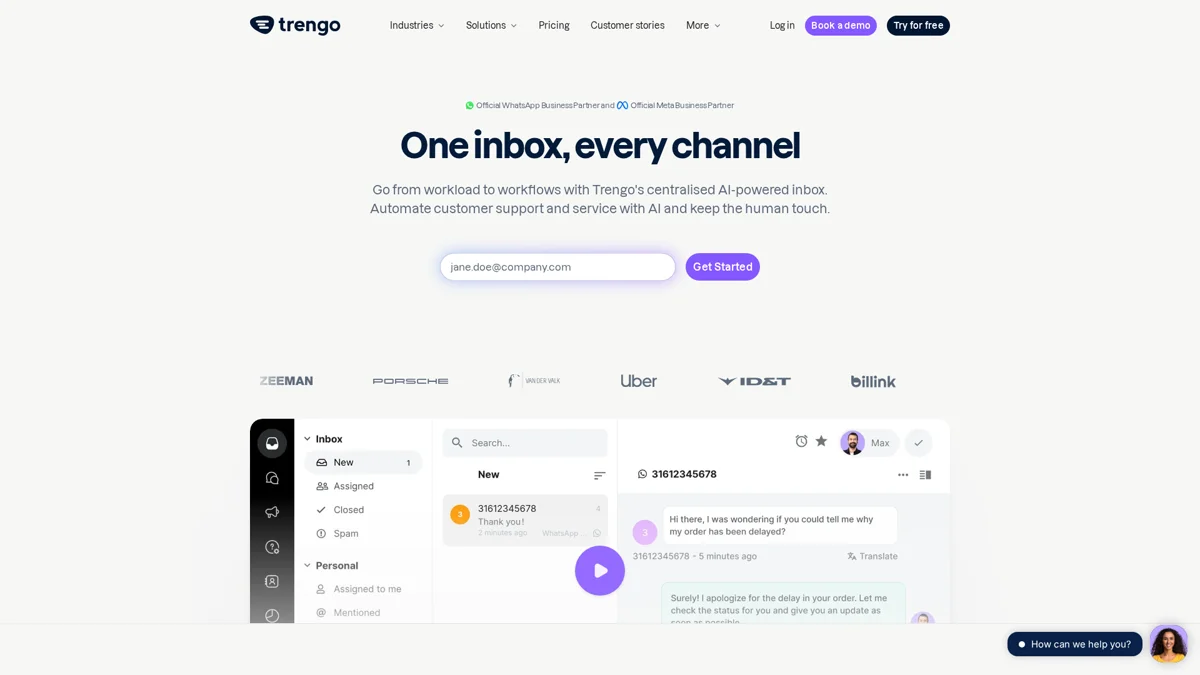
What features does Trengo offer?
Trengo's feature set is built around what its target customer base values most — its biggest differentiator versus the alternatives below. It uses a usage-based pricing model starting at €299/mo, a different cost structure from a flat-rate alternative like Converge ($49/month for up to 15 agents, all channels and AI included). Features typically split across channel coverage, automation depth, AI tooling, and team management — the grid below shows what matters most for a unified-inbox use case.
Why should you look for Trengo alternatives?
Teams look for Trengo alternatives because of structural limitations in its plans and channel coverage — pain points that compound as the team scales past initial setup.
What does Trengo's inbox actually include?
Trengo's inbox centralizes WhatsApp Business API, email, live chat, Facebook Messenger, Instagram DMs, Telegram, TikTok, SMS, and voice (add-on) into a shared team inbox (help.trengo.com, checked 18 September 2026). The WhatsApp integration is Trengo's strongest channel — as an official WhatsApp Business Solution Provider (BSP), Trengo supports both inbound customer service and outbound broadcasting for marketing campaigns. Broadcasting is sold as a separate add-on on all plans (trengo.com/prices, 2026). AI HelpMate operates as an autonomous agent that suggests and sends responses automatically, trained on knowledge base content. AI Journeys automate multi-step conversation workflows across channels. Flowbot provides a no-code visual builder for FAQ routing and common workflows. Collaboration features include @mentions, internal comments, conversation assignment, role-based permissions, conversation labels, and CSAT surveys. Reporting covers agent performance and AI resolution metrics.
Which Trengo features are gated behind the Pro tier?
Feature gating between plans is sharper than the two headline prices suggest, and the live comparison table is worth reading line by line. Boost is marked Not supported for custom channel integrations, custom integrations with internal tools, and API actions triggered from AI flows — so the AI agent on Boost can answer from your knowledge base but cannot call your order system to look anything up. Boost is also marked Not available for live chat support, phone support, and mandatory 2FA, meaning a security policy requiring enforced two-factor authentication across the team is a €200/month upgrade rather than a settings toggle. Pro unlocks all of those but keeps the dedicated success manager at Enterprise only, and voice and broadcasting remain add-ons at every tier (trengo.com/prices, checked 18 September 2026).
How does Trengo count a conversation?
Trengo publishes two different definitions of the billable unit, and the difference decides whether your unanswered inbound messages cost money. The tooltip on the pricing plan table reads “any reply to an inbound or outbound message with a customer that occurs within a 7-day window”. The FAQ further down that same page, and the help centre article, both say something narrower: a conversation is “an outbound message that starts in Trengo, either as the first touch point with a customer or as a reply to a customer's inbound conversation” (help.trengo.com, updated 17 September 2025).
Read together, the narrower wording is the operative one: metering starts when you send, not when the customer does. A spam message you never answer is free. The 7-day window is the expensive half — the help centre states plainly that once the window concludes it “will be counted as two conversations”, so one support thread that runs across a fortnight bills twice, and a customer who returns each month with the same recurring question generates twelve billable conversations a year rather than one relationship. Auto-replies are excluded from the count on both billing modes, which is a real concession, but a Flowbot that hands off to a human is not.
Where does Converge's channel coverage differ?
Converge includes all nine of its messaging channels at $49/month with no tier gating or conversation caps — an embeddable chat widget plus WhatsApp, Telegram, Discord, Instagram, Zalo OA, Messenger, email on your own IMAP/SMTP mailbox, and X. AI reply suggestions with configurable tone (professional, friendly, casual) and quick reply matching are included without credit limits; teams can bring their own API key for AI features. The chat widget provides visitor tracking, UTM attribution, session management, FAQ self-service, suggested messages, and CSAT collection. Converge does not offer voice calling, SMS, TikTok, WhatsApp broadcasting, Flowbot-style chatbot builders, or a HubSpot integration; it does ship a Shopify connector that surfaces a shopper's live cart and current browsing in the agent sidebar. The tradeoff is clear: Converge is a focused messaging inbox with broader channel coverage; Trengo bundles more tools (voice, broadcasting, chatbot builder) at a higher price with usage metering.
Strengths
- Strong WhatsApp Business API support
- Flowbot no-code automation for common workflows
- AI HelpMate agent for automated responses
- European company with GDPR compliance built in
Limitations
- Starts at €299/month for a fixed 10-seat package, and only at that price on annual billing
- Overage costs 10% more than the per-conversation rate you already agreed to
- Monthly plans forfeit unused conversations; annual plans roll them over
- No Discord or Zalo channel on any plan
How much does Trengo cost?
Trengo pricing starts at €299/mo on a usage-based model — but that listed price rarely reflects what teams actually pay. Real cost depends on team size and how the model scales with headcount, channel count and per-channel surcharges, premium-tier gating that surfaces after signup, and add-ons for advanced reporting, premium support, or compliance. The tier breakdown below lists what each plan includes alongside its monthly price.
What does Trengo actually charge in 2026?
Verified against trengo.com/prices on 18 September 2026, with the currency toggle set to EUR. Nothing on the plan cards or the add-on table had moved since our previous check a month earlier:
- Boost: €299/month annual or €349/month monthly — 10 users included; 6,000 conversations/year on annual, 500/month on monthly. Unified inbox, WhatsApp Business API, AI HelpMate, AI Journeys (beta), website widget, custom fields, contact groups, views, agent performance and AI reporting. Marked Not supported for custom channel integrations, custom integrations, and API actions in AI flows; Not available for live chat support, phone support, dedicated success manager, and mandatory 2FA.
- Pro: €499/month annual or €599/month monthly — 20 users included; 18,000 conversations/year on annual, 1,500/month on monthly. Adds developer access for custom channels, custom integrations via APIs, API actions in AI flows, live chat and phone support, and optional mandatory 2FA. Still no dedicated success manager.
- Enterprise: sales-quoted — custom users and conversation volume, dedicated success manager, custom-built integrations, and voice as a full integration rather than an add-on.
Which Trengo costs are not on the pricing card?
The add-on table sits below the plan cards and carries the numbers that decide your real invoice. Extra conversations run €18 per 100 monthly, €15 per 100 annually. Extra users are €30/user on Boost and €50/user on Pro monthly, dropping to €25 and €40 annually. Any conversation handled by AI HelpMate carries a surcharge of €0.30 monthly or €0.25 annually on top of the conversation itself. Voice calling and broadcasting are add-ons on every tier. WhatsApp service conversations are listed as free, but WhatsApp, voice, and SMS traffic that triggers an AI surcharge is billed per usage at each channel's rate.
The item that catches teams out is not on the pricing page at all. Trengo's help centre documents a 10% penalty on unplanned overage: at cycle end, the open balance is multiplied by your bundle price and then a further 10% fee is applied. Their worked example is 45 excess conversations at €0.18 each billing as €8.91 rather than €8.10 (help.trengo.com, updated 19 March 2025). Buying conversation blocks ahead of time avoids the surcharge — but those blocks are one-time only and do not raise your recurring commitment, so the next cycle starts from the committed number again.
What does a year on Trengo actually cost if your volume is seasonal?
On identical traffic, a seasonal business on monthly billing pays roughly €927 more per year than the same business on annual billing — and only €600 of that is the advertised price difference. The rest is quota you paid for and were not allowed to keep: Trengo's help centre states that monthly subscribers who do not use the full quota lose the remainder with no refund, while yearly subscribers carry it forward because the cycle spans the whole year (help.trengo.com, updated 17 September 2025). Here is the arithmetic, using only the rates linked above and a business that runs 250 conversations in each of six quiet months and 900 in each of six peak months, 6,900 for the year:
- Annual billing (Boost, €299/month). Base cost €3,588. The allowance is 6,000 conversations for the year and quiet-month surplus carries forward, so the whole 6,900 draws against one pot: 900 over, at €15 per 100, is €135, plus the 10% fee = €148.50. Year total: €3,736.50.
- Monthly billing (Boost, €349/month). Base cost €4,188. Each quiet month uses 250 of its 500 and forfeits the other 250 with no refund, so none of that 1,500-conversation surplus is available later. Each peak month runs 400 over its 500 cap: 400 at €0.18 is €72, plus 10% = €79.20, six times over = €475.20. Year total: €4,663.20.
The €926.70 gap is the point. The pricing page frames monthly versus annual as a €50/month convenience premium, and for a business with flat volume that is exactly what it is. For a business with a peak — which is most retail, travel and hospitality — the forfeiture rule quietly converts the quiet months into a second, unadvertised charge, because the surplus that would have absorbed the peak has already been deleted. The alerting reflects this asymmetry too: monthly subscribers are warned at 75%, 90% and 100% of usage, annual subscribers at 50%, 75%, 90% and 100%, so the billing mode with less room to recover also gets less notice.
Can you just refuse to go over the cap?
No, because Trengo does not enforce the cap as a cap. The help centre's closing line is unambiguous: if you have not purchased additional conversations, “your message will still be sent. However, you will be subject to an overage surcharge.” There is no setting that stops an agent replying, and stopping them would mean refusing to answer customers. The practical consequence is that the conversation allowance is not a budget you can hold to; it is a threshold above which your unit price silently rises by 10%. Teams that want a hard ceiling on spend have to get it from the pricing model itself rather than from a control inside the product — which is the structural reason flat-rate inboxes keep showing up on this shortlist, and the same reason per-agent tools like Zendesk Chat alternatives appeal to teams who would rather have a predictable headcount line than a variable usage line.
What does a 10- or 15-agent team pay, side by side?
Converge is $49/month flat for up to 15 team members, all channels included, unlimited conversations, AI reply suggestions with no credit system, and a 7-day trial with no credit card. A 10-agent team fits Trengo Boost exactly and pays €299/month against a metered allowance; the same team on Converge pays $49/month with nothing metered. At the ECB euro reference rate of 1.1481 on 17 September 2026, €299 is about $343, so the gap is roughly $294/month or $3,500/year before a single overage line — and that conversion is the one number here that moves on its own, so re-run it at today's rate rather than trusting ours.
A 15-agent team cannot use Boost as sold, because Boost includes 10 users. The two routes are Pro at €499/month, or Boost plus five extra seats — €299 + 5 × €25 = €424/month on annual billing, or €349 + 5 × €30 = €499/month on monthly, which is the point where padding Boost costs exactly what Pro costs annually while still leaving every Boost feature gate in place. That is the seat arithmetic worth doing before a sales call: the cheaper-looking tier stops being cheaper somewhere between the eleventh and fifteenth agent, and where it stops depends on your billing mode rather than on your team.
What are the top Trengo alternatives?
Side-by-side breakdown of features, pricing, and trade-offs.
The top Trengo alternatives split into two categories serving different team profiles. First, messaging-first unified-inbox platforms built for 3-15 agent teams handling real-time conversations across channels — Converge sits in this category at $49/month flat. Second, traditional ticketing and helpdesk platforms built for larger teams with email-heavy or compliance-heavy workflows. The comparison below covers features, pricing model, and best-fit team type for each.
Converge
Best ValueMessaging-first unified inbox. Flat pricing, all channels included.
Strengths
- $49/month flat rate for up to 15 agents
- Native WhatsApp, Telegram, Messenger, Discord, Zalo
- Unified inbox for real-time conversations
Limitations
- No standalone knowledge base
- Not suited for email-heavy workflows
- No HIPAA/SOC2 compliance

Zendesk
Customer service software and support ticketing system
Strengths
- Industry-leading ticketing system with mature workflows
- Marketplace of 1,800+ apps, partners and integrations
- Enterprise-grade security and compliance (HIPAA, SOC2)
Limitations
- Per-agent pricing scales quickly -- add-ons can double the per-seat rate
- AI Copilot is $50/agent/mo extra on top of base plan
- AI resolutions above the plan allowance are billed per resolution at an unpublished rate

Freshdesk
Cloud-based customer support software by Freshworks
Strengths
- Mature platform with proven reliability at scale
- Email-only teams can pay $19/agent/mo rather than buying messaging they will not use
- Strong automation and workflow capabilities
Limitations
- Two separate product lines priced differently — pick the wrong one and messaging costs a migration, not an upgrade
- Omnichannel messaging requires Omni plans ($29+/agent/mo)
- AI Copilot is $29/agent/mo extra and unavailable at all on Growth or Omni Growth

Intercom
AI-first customer service platform
Strengths
- Fin AI Agent resolves queries autonomously with high accuracy
- Beautiful, modern interface design
- Strong product tour and in-app onboarding features
Limitations
- Per-outcome Fin AI fees ($0.99 each) add up fast at volume
- Premium per-seat pricing plus Pro and Proactive Support add-ons can reach $150+/seat/mo effective
- No Zalo channel in Intercom's channel list

Help Scout
Customer service platform for growing businesses
Strengths
- Clean, intuitive interface loved by support teams
- Excellent email-focused support with collision detection
- Strong knowledge base (Docs) for self-service
Limitations
- WhatsApp only available on Plus tier ($45/user/mo)
- No native Telegram, Discord, or Zalo support
- AI Answers charged per resolution ($0.75 each)
How do Trengo alternatives compare?
Compared head-to-head, Converge ($49/month flat for up to 15 agents) is consistently the cheapest option for messaging-first teams under 15 agents and includes WhatsApp, Telegram, Messenger, Instagram, Discord, and Zalo plus AI tooling in the base subscription. The other major Trengo alternatives use per-seat models that scale linearly with headcount, compounding past the 3-5 agent threshold. The table below shows starting prices and best-fit profiles for each alternative.
Which Trengo alternative is best for messaging-first SMBs?
For messaging-first SMBs under 15 agents, Converge is consistently the best Trengo alternative on the dimensions that matter in practice. It includes native support for WhatsApp, Telegram, Messenger, Instagram, Discord, and Zalo Official Accounts at $49/month flat for up to 15 agents — no per-seat fees, no per-channel add-ons, no premium-tier gating around AI features. The verdict below shows where teams choose Converge and where a different platform fits better.
If your team primarily uses messaging channels (WhatsApp, Telegram, Messenger, Instagram, Discord, Zalo) and wants predictable pricing, Converge is worth considering.
Why teams choose Converge
- $49/month flat rate for up to 15 agents
- Native messaging channels most treat as add-ons
- Unified inbox for real-time conversations
When to choose something else
- Enterprise compliance (HIPAA, SOC2)
- Email/ticket-heavy workflows
- Advanced automation requirements
What is the best Trengo alternative for small teams?
For teams under 15 agents, the best Trengo alternative is usually a flat-rate unified inbox rather than another conversations-metered platform. Trengo's Boost plan bills €299/month for a 10-user package with 6,000 conversations/year — roughly €100 per actually-used seat for a 3-person team, plus overage billed at the bundle rate with a 10% surcharge on top once you pass it (trengo.com/prices and help.trengo.com, both checked 18 September 2026). A flat-rate alternative like Converge charges $49/month for up to 15 agents with unlimited conversations and no usage metering, which removes the seat over-provisioning, the overage surcharge, and the monthly-plan forfeiture of unused quota in one step. It also covers two channels Trengo offers on no plan — Discord support for community-led teams and Zalo support for the Vietnamese market. If you specifically need WhatsApp broadcasting, voice calling, or Trengo's Flowbot chatbot builder, weigh that against the pricing gap — those are the capabilities a messaging-first inbox typically does not replace.
Choose Trengo if:
- You need voice calling alongside messaging in a unified inbox (available as an add-on)
- WhatsApp Business API broadcasting for marketing outreach is part of your workflow
- You want an autonomous AI chatbot (HelpMate) that handles full conversations without agent involvement
- Your team needs native Shopify, HubSpot, Salesforce, or Dynamics 365 integrations
- You are based in Europe and value Dutch/EU-based vendors with GDPR-compliant AWS Frankfurt hosting
- You need a no-code conversation flow builder (Flowbot, AI Journeys) for automated workflows
Choose Converge if:
- You need native Discord or Zalo channel support (Trengo does not offer either)
- You want all channels and AI reply suggestions at $49/month flat — no conversation caps, no overage fees, no seat packages
- Your team is 3–15 agents, where Trengo's minimum €299/month for a fixed 10-seat package is oversized at the bottom and short of seats at the top
- You need visitor tracking with UTM attribution, beacon tracking, and lead capture in your chat widget
- Predictable pricing matters — no conversation overages, no 10% surcharge on excess, no per-AI-conversation fee
- You prefer a focused messaging inbox over a bundled platform with voice, SMS, and chatbot builder
Frequently Asked Questions
The best Trengo alternative depends on what pushed you to switch. If the conversations-based pricing and forced 10-user packages are the problem, a flat-rate unified inbox like Converge ($49/month for up to 15 agents, unlimited conversations) removes both. If you need a like-for-like omnichannel inbox with WhatsApp broadcasting and voice, Front and Respond.io are the closest feature matches but use per-seat or usage-based pricing. For European GDPR-focused teams, the EU-hosted options matter most. There is no single best pick — match the alternative to whether your blocker is price, channels, or compliance. If your blocker is the AI agent or the Flowbot builder, no flat-rate messaging inbox replaces those, and switching will cost you capability.
Trengo does not block the message — it sends, then bills you at the end of the cycle with a 10% penalty on top. Trengo's help centre states the open balance is multiplied by your conversation bundle price and then an additional 10% fee is applied, and gives this worked example: 45 excess conversations at €0.18 each bills as (45 × €0.18) plus 10% = €8.91 (help.trengo.com, conversation usage and additional charges, updated 19 March 2025). The same help centre is explicit that if you have not bought extra conversations in advance, the message still sends and you are simply subject to the surcharge — so the allowance is a price threshold, not a spending limit you can hold to. Buying blocks in advance avoids the 10%, but one-time blocks do not roll into your recurring commitment, and the next cycle resets to your committed amount. That is the mechanic behind most complaints about unpredictable Trengo invoices.
Annual, and by considerably more than the €50/month sticker difference on Boost. Take a business running 250 conversations in each of six quiet months and 900 in each of six peak months — 6,900 for the year. On annual billing the €299/month base costs €3,588, the 6,000-conversation allowance is pooled across the whole year, and the 900 excess bills at €15 per 100 plus the 10% fee, or €148.50: €3,736.50 all in. On monthly billing the €349/month base costs €4,188, each quiet month forfeits 250 unused conversations with no refund, and each of the six peak months runs 400 over its 500 cap at €0.18 plus 10%, or €79.20 a month: €4,663.20 all in. That is €926.70 more for identical traffic, of which only €600 is the advertised price gap. The remainder is quiet-month quota that annual billing would have carried into the peak. Figures derived from the rates published on trengo.com/prices and the forfeiture rule in Trengo's help centre, both checked 18 September 2026.
Only on annual plans. Trengo's help centre is explicit: monthly subscribers who do not use the full quota lose the remainder with no refund, while yearly subscribers carry unused conversations to the next month because the cycle spans the whole year (help.trengo.com, Conversations in Trengo, updated September 2025). This makes the monthly-vs-annual choice bigger than the headline €299 vs €349 gap on Boost. Seasonal businesses on monthly billing pay full price through quiet months, then hit the 10% overage surcharge during peak — the exact months annual billing would have covered from banked quota. Auto-replies are excluded from the count on both billing modes.
Trengo has no Discord or Zalo channel on any plan, so teams that need those have to look elsewhere. Trengo's own social-media channel index, checked on 18 September 2026, lists exactly four: Facebook, Instagram, Telegram and TikTok. Converge has native Discord (bot token plus app ID) and Zalo OA support alongside WhatsApp, Telegram, Messenger, Instagram, X, email on your own IMAP/SMTP mailbox, and an embeddable widget — at $49/month flat for up to 15 agents. Native Zalo integration in particular is rare among unified-inbox platforms, which matters for businesses serving the Vietnamese market, and Discord matters for gaming, crypto and developer communities that run support inside their server. The trade runs both ways: Trengo documents a TikTok channel and Converge does not, so a team whose customers message through TikTok DMs should not treat this as a one-sided gap.
The top Trengo alternatives are Zendesk, Freshdesk, Intercom, and Converge. Each offers different strengths: Zendesk for Large enterprises needing comprehensive ticketing, and Converge for messaging-first teams with flat $49/month pricing.
Trengo starts at €299/mo. Additional costs may include add-ons, annual billing requirements, and implementation fees.
Trengo can work for small businesses. Alternatives like Converge offer flat-rate pricing ($49/month for up to 15 agents) better suited for SMBs.
Trengo's main limitations include: Starts at €299/month for a fixed 10-seat package, and only at that price on annual billing; Overage costs 10% more than the per-conversation rate you already agreed to; Monthly plans forfeit unused conversations; annual plans roll them over. These factors lead many teams to explore alternatives.
Trengo at €299/mo is on the higher end compared to alternatives. Zendesk starts at $19/seat/mo. Converge offers flat $49/month for up to 15 agents, eliminating per-seat scaling.
Ready to try Converge?
$49/month flat. Up to 15 agents. 7-day free trial, no credit card required.
Start Free Trial