
Chatwoot Alternatives 2026
Chatwoot is open-source customer engagement platform. Best suited for technical teams wanting open-source flexibility. Known for its open-source with self-hosting option.

Messaging-first unified inbox with flat pricing. WhatsApp, Telegram, Messenger, Discord, Zalo in one place.
Zendesk is customer service software and support ticketing system. Best suited for large enterprises needing comprehensive ticketing with compliance requirements and deep third-party integrations. Known for its industry-leading ticketing system with a marketplace of 1,800+ apps, partners and integrations, and enterprise-grade compliance.
Freshdesk is Freshworks' customer support platform, sold as two separate product lines: standard Freshdesk (email-first ticketing, $19-$89/agent/mo) and Freshdesk Omni (messaging plus ticketing, $29-$119/agent/mo). We re-checked both Freshworks pricing pages on 5 August 2026 — the long-running Free plan is gone from the public rate card and survives only as an in-app, six-month, two-agent Free Program on the standard line. Freddy AI is the standout, but Copilot is a $29/agent/mo add-on on top of whichever plan you pick.
Intercom is an AI-first customer service platform best suited for well-funded SaaS companies that want product tours, in-app messaging, and an AI agent that answers front-line questions. Checked 3 August 2026: the three per-seat plans (Essential, Advanced, Expert) still list at $29, $85, and $132 per seat annually, and Fin AI still bills $0.99 per outcome — so the headline seat price is rarely the real cost. Two things did change this year: the company renamed itself Fin in May 2026, and Salesforce signed a definitive agreement to acquire it in June 2026. The helpdesk product keeps the Intercom name.
Help Scout is customer service platform for growing businesses. Best suited for small-medium businesses wanting a clean, email-focused helpdesk with strong knowledge base and self-service features. Known for its docs knowledge base with AI Answers for self-service resolution.
Chatwoot is an open-source customer engagement platform backed by Y Combinator (W21), with more than 36,000 stars on its GitHub repository (36,792 stars and 8,911 forks when we checked in September 2026). Chatwoot covers website live chat, email, Facebook, Instagram, TikTok, WhatsApp, Voice, SMS, Telegram, LINE, and an API channel. The distinguishing factor is the self-hosted Community Edition, which teams can run on their own infrastructure with no licence fee. One detail worth reading before you treat that as "open source, full stop": the repository is not wholly MIT. Chatwoot's LICENSE file places everything under the enterprise/ directory under a separate commercial licence and leaves third-party components on their own terms — only the code outside those is MIT Expat, which is why GitHub's API reports the repository licence as "Other" rather than MIT. Cloud plans run from $0 (Hacker, 2 agents, live chat only) to $99/agent/month (Enterprise), all billed annually, with a 15-day free trial (Chatwoot pricing, checked September 2026). Captain AI — reply suggestions, summaries, and an assistant chatbot — runs on a credit system, with overages charged at $20 per 1,000 credits.
Converge is a cloud-only messaging inbox at $49/month flat for up to 15 team members. It covers nine channels: WhatsApp, Telegram, Discord, Instagram, Zalo OA, Facebook Messenger, X (Twitter), email through your own mailbox over IMAP/SMTP, and an embeddable chat widget with visitor tracking, UTM attribution, and lead capture. The core difference: Chatwoot offers self-hosting and a wider channel range (TikTok, LINE, SMS, Voice); Converge offers flat pricing, AI reply suggestions with no credit meter, and native Discord and Zalo — channels Chatwoot does not cover.
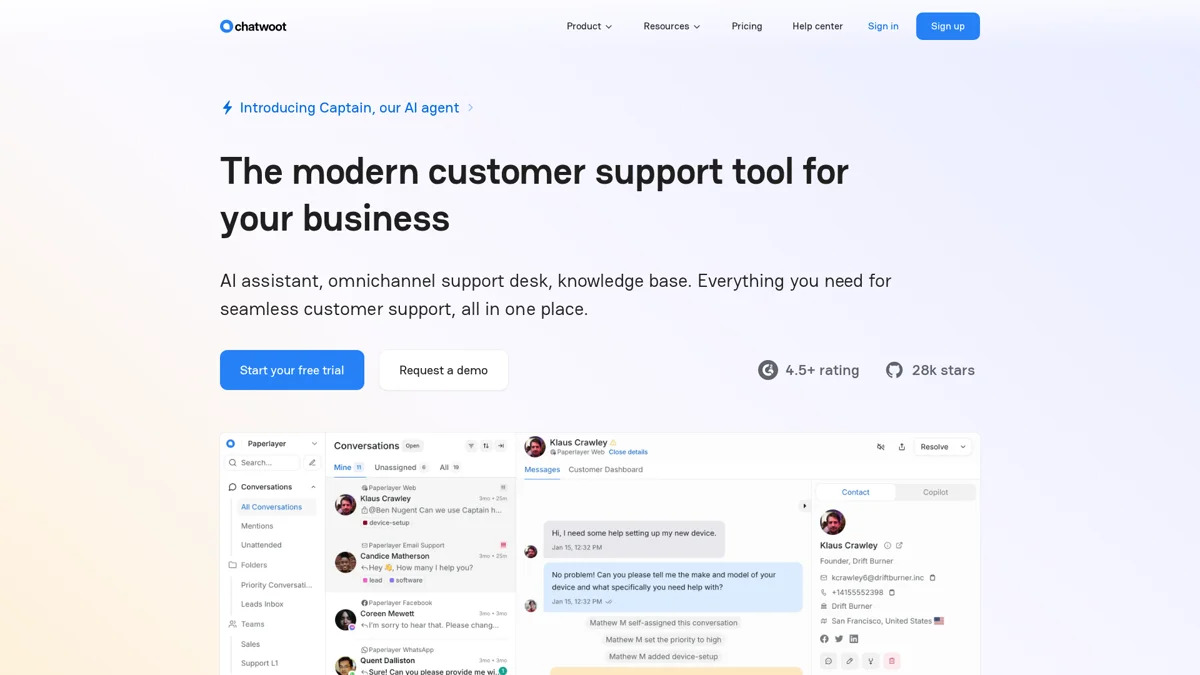
What features does Chatwoot offer?
Chatwoot's feature set is built around what its target customer base values most — its biggest differentiator versus the alternatives below. It uses a per seat pricing model starting at $19/seat/mo, a different cost structure from a flat-rate alternative like Converge ($49/month for up to 15 agents, all channels and AI included). Features typically split across channel coverage, automation depth, AI tooling, and team management — the grid below shows what matters most for a unified-inbox use case.
Why should you look for Chatwoot alternatives?
Teams look for Chatwoot alternatives because of structural limitations in its plans and channel coverage — pain points that compound as the team scales past initial setup.
Chatwoot's feature set is broad for an open-source platform. The shared inbox centralizes website live chat, email, Facebook, Instagram, WhatsApp, Telegram, TikTok, LINE, SMS, Voice, and a custom API channel. Canned responses, private notes, @mentions, keyboard shortcuts, and a command bar are available on all plans including the free tier. The help center (knowledge base) ships on Startups ($19/agent/mo) and above, as do CSAT surveys, downloadable reports, custom views, business hours, and auto-responders.
Feature gating across tiers is where the plan choice actually gets decided. Teams and automation rules — two things most growing support teams need — require the Business plan at $39/agent/month, and so do SLA policies, custom attributes, pre-chat forms, CSAT review notes, Voice, and WhatsApp/SMS campaigns. Only SSO/SAML, audit logs, agent capacity, and branding removal sit behind Enterprise at $99/agent/month (Chatwoot pricing, checked September 2026). That distinction matters when you are budgeting: SLA tracking is frequently described as an enterprise feature, but on Chatwoot's cloud plans it arrives at $39, not $99. Captain AI ships with each paid plan at different credit allotments: 300 (Startups), 500 (Business), 800 (Enterprise). Those credits cover reply suggestions, conversation summaries, a customer-facing AI assistant chatbot, and a content gap analyzer for the help center (Chatwoot Captain, checked September 2026). Once they run out, further usage costs $20 per 1,000 credits — a variable line item that is hard to forecast when support volume moves week to week.
Converge includes all nine of its channels at $49/month with no tier gating: WhatsApp, Telegram, Discord, Instagram, Zalo OA, Facebook Messenger, X (Twitter), email through your own mailbox over IMAP/SMTP, and the embeddable widget. AI reply suggestions with tone configuration (professional/friendly/casual) and quick reply matching are included without a credit system — teams can also bring their own API key for AI features. The chat widget provides visitor tracking with beacon data (device, location, referrer), UTM attribution, session persistence, FAQ self-service, suggested messages, and CSAT collection. Converge includes auto-routing (round-robin or load-balanced), SLA policies, auto-reply with A/B testing, and customer lifecycle tracking at the base price. Converge does not offer a knowledge base, TikTok DMs, LINE, SMS, Slack integration, or self-hosting. For teams that need an all-in-one help desk with knowledge base and chatbot builder, Chatwoot covers more ground. For teams focused on messaging inbox efficiency with website visitor intelligence, Converge delivers more at a lower price.
Strengths
- Open-source option available
- Good channel coverage
- Active development community
- Self-hosting possible
Limitations
- Per-agent pricing model
- Self-hosting requires technical expertise
- Limited advanced features in lower tiers
- No Discord or Zalo support
How much does Chatwoot cost?
Chatwoot pricing starts at $19/seat/mo on a per seat model — but that listed price rarely reflects what teams actually pay. Real cost depends on team size and how the model scales with headcount, channel count and per-channel surcharges, premium-tier gating that surfaces after signup, and add-ons for advanced reporting, premium support, or compliance. The tier breakdown below lists what each plan includes alongside its monthly price.
What do Chatwoot's cloud plans cost?
Chatwoot cloud pricing, billed annually, per agent per month (Chatwoot pricing, checked September 2026). Chatwoot Cloud runs on AWS with servers in the US, and every paid tier starts with a 15-day free trial:
- Hacker (Free): $0 — up to 2 agents, 500 conversations/month, live chat only (no email, no social), no Captain AI, no help center, no teams, no automation, 30-day data retention
- Startups: $19/agent/month — unlimited conversations under fair use, every channel except Voice, 300 Captain AI credits/month, help center, 1-year retention. No teams, no automation rules, no custom attributes, no SLA
- Business: $39/agent/month, Chatwoot's own "most popular" pick — 500 AI credits, Voice, teams, automation rules, custom attributes, pre-chat forms, SLA policies, WhatsApp and SMS campaigns, CSAT review notes, 2-year retention
- Enterprise: $99/agent/month — 800 AI credits, SSO/SAML, audit logs, agent capacity, branding removal, 3-year retention. The dedicated account manager and video or voice support apply only to subscriptions of 20 agents or more
The Startups plan is free for open-source projects and registered nonprofits, which is worth asking about before you pay for it.
What does self-hosting Chatwoot cost?
Self-hosted pricing (Chatwoot self-hosted plans, checked September 2026):
- Community Edition (Free): free forever on your own infrastructure, no agent limits, no licence fee — but no Captain AI, no voice calls, no custom branding, no agent capacity, no roles and permissions, no SSO, no SLA, and support only through Discord and GitHub. Requires a Linux server (production minimum 4GB RAM and 2 CPU cores), PostgreSQL, Redis, and S3 or S3-compatible storage for uploads; Docker and Kubernetes deploy guides are published
- Premium Support: $19/agent/month — adds Captain AI, voice calls, custom branding, agent capacity, roles and permissions, and priority email support. It still has no SSO and no SLA policies, which is the detail most teams get wrong when they budget the self-hosted route
- Enterprise Edition: $99/agent/month — adds SSO/SAML and SLA policies, phone support, and developer office hours. Dedicated account management and video or voice support again require 20+ agents on an annual contract
Which Chatwoot costs are not on the pricing page?
Costs that sit outside the table: Captain AI overages at $20 per 1,000 credits; WhatsApp Business API per-conversation fees charged by Meta through your BSP; SMS delivery fees through Twilio or equivalent; and for self-hosting, the server, database backups, and monitoring ($20–$100+/month before anyone's time is counted). The Hacker plan's 30-day retention and 500-conversation cap make it an evaluation tier rather than a production one — most teams start at Startups, where a 5-agent team costs $95/month and a 10-agent team costs $190/month, still without automation or teams.
Converge: $49/month flat for up to 15 team members, all nine channels, AI reply suggestions with no credit meter, 7-day free trial with no credit card (against Chatwoot's 15 days, which is the fairer comparison to make). A 5-agent team on Chatwoot Startups pays $95/month without automation; on Business, where the automation and SLA policies actually live, $195/month. A 10-agent Business team pays $390/month. Converge includes auto-routing, auto-reply, SLA policies, and AI suggestions at $49/month — a 75–92% cost reduction against the equivalent Chatwoot cloud configurations.
What are the top Chatwoot alternatives?
Side-by-side breakdown of features, pricing, and trade-offs.
The top Chatwoot alternatives split into two categories serving different team profiles. First, messaging-first unified-inbox platforms built for 3-15 agent teams handling real-time conversations across channels — Converge sits in this category at $49/month flat. Second, traditional ticketing and helpdesk platforms built for larger teams with email-heavy or compliance-heavy workflows. The comparison below covers features, pricing model, and best-fit team type for each.
Converge
Best ValueMessaging-first unified inbox. Flat pricing, all channels included.
Strengths
- $49/month flat rate for up to 15 agents
- Native WhatsApp, Telegram, Messenger, Discord, Zalo
- Unified inbox for real-time conversations
Limitations
- No standalone knowledge base
- Not suited for email-heavy workflows
- No HIPAA/SOC2 compliance

Zendesk
Customer service software and support ticketing system
Strengths
- Industry-leading ticketing system with mature workflows
- Marketplace of 1,800+ apps, partners and integrations
- Enterprise-grade security and compliance (HIPAA, SOC2)
Limitations
- Per-agent pricing scales quickly -- add-ons can double the per-seat rate
- AI Copilot is $50/agent/mo extra on top of base plan
- AI resolutions above the plan allowance are billed per resolution at an unpublished rate

Freshdesk
Cloud-based customer support software by Freshworks
Strengths
- Mature platform with proven reliability at scale
- Email-only teams can pay $19/agent/mo rather than buying messaging they will not use
- Strong automation and workflow capabilities
Limitations
- Two separate product lines priced differently — pick the wrong one and messaging costs a migration, not an upgrade
- Omnichannel messaging requires Omni plans ($29+/agent/mo)
- AI Copilot is $29/agent/mo extra and unavailable at all on Growth or Omni Growth

Intercom
AI-first customer service platform
Strengths
- Fin AI Agent resolves queries autonomously with high accuracy
- Beautiful, modern interface design
- Strong product tour and in-app onboarding features
Limitations
- Per-outcome Fin AI fees ($0.99 each) add up fast at volume
- Premium per-seat pricing plus Pro and Proactive Support add-ons can reach $150+/seat/mo effective
- No Zalo channel in Intercom's channel list

Help Scout
Customer service platform for growing businesses
Strengths
- Clean, intuitive interface loved by support teams
- Excellent email-focused support with collision detection
- Strong knowledge base (Docs) for self-service
Limitations
- WhatsApp only available on Plus tier ($45/user/mo)
- No native Telegram, Discord, or Zalo support
- AI Answers charged per resolution ($0.75 each)
How do Chatwoot alternatives compare?
Compared head-to-head, Converge ($49/month flat for up to 15 agents) is consistently the cheapest option for messaging-first teams under 15 agents and includes WhatsApp, Telegram, Messenger, Instagram, Discord, and Zalo plus AI tooling in the base subscription. The other major Chatwoot alternatives use per-seat models that scale linearly with headcount, compounding past the 3-5 agent threshold. The table below shows starting prices and best-fit profiles for each alternative.
Which Chatwoot alternative is best for messaging-first SMBs?
For messaging-first SMBs under 15 agents, Converge is consistently the best Chatwoot alternative on the dimensions that matter in practice. It includes native support for WhatsApp, Telegram, Messenger, Instagram, Discord, and Zalo Official Accounts at $49/month flat for up to 15 agents — no per-seat fees, no per-channel add-ons, no premium-tier gating around AI features. The verdict below shows where teams choose Converge and where a different platform fits better.
If your team primarily uses messaging channels (WhatsApp, Telegram, Messenger, Instagram, Discord, Zalo) and wants predictable pricing, Converge is worth considering.
Why teams choose Converge
- $49/month flat rate for up to 15 agents
- Native messaging channels most treat as add-ons
- Unified inbox for real-time conversations
When to choose something else
- Enterprise compliance (HIPAA, SOC2)
- Email/ticket-heavy workflows
- Advanced automation requirements
Choose Chatwoot if:
- You have DevOps resources and want to self-host for data sovereignty — the Community Edition has no licence fee and no agent limits on your own infrastructure
- You need TikTok DMs, LINE, SMS, or Voice support — channels Converge does not cover
- You want a codebase you can fork and modify for custom workflows, and you have read the LICENSE file closely enough to know the MIT Expat grant stops at the
enterprise/directory, which is commercially licensed - You need a built-in knowledge base (help center) tightly integrated with an AI chatbot assistant
- Your organization requires SSO/SAML and audit logs (Enterprise plan, $99/agent/month)
- You operate in a regulated environment where controlling the server stack and data residency is non-negotiable
Choose Converge if:
- You want all channels and AI reply suggestions at $49/month flat — no per-seat scaling, no AI credit caps
- You need native Discord or Zalo support (Chatwoot does not offer either channel)
- Your team is 5–15 agents, where Chatwoot's per-agent pricing runs from $195/month (5 agents on Business at $39) to $1,485/month (15 agents on Enterprise at $99)
- You need a chat widget with visitor tracking, UTM attribution, beacon data, and lead capture built in
- You want auto-routing, SLA policies, and auto-reply with A/B testing included without upgrading to a higher tier
- You prefer managed infrastructure with zero server maintenance over self-hosted control
- Predictable monthly billing matters — no credit overages, no per-agent multiplication, no annual lock-in surprises
Frequently Asked Questions
In the Chatwoot dashboard, go to the Contacts screen and click the Export button. Chatwoot generates a CSV file that is emailed to your administrator account. Since PR #9347 (May 2024), the export respects any active filters, segments, and labels you've applied — so you can export a targeted subset or all contacts at once. The CSV includes name, email, phone number, and custom attributes. This feature is available on all plans including the free Hacker tier. You need admin privileges to trigger the export.
Chatwoot does not offer a one-click conversation export in the UI. To retrieve conversation history, use the REST API: GET /api/v1/accounts/{account_id}/conversations to list conversations (filterable by status, assignee, inbox, team, and labels), then GET /api/v1/accounts/{account_id}/conversations/{id}/messages for each conversation's full message history. There is no single bulk export endpoint — you must iterate conversation by conversation. For self-hosted instances, you can bypass the API entirely and export everything directly using pg_dump on the PostgreSQL database.
Yes. Chatwoot's REST API covers contacts, conversations, messages, canned responses, and labels. To authenticate, generate a Personal Access Token from your avatar > Profile Settings > Access Token, then include it as a header: api_access_token: your_token_here. Admin tokens can access all account data; agent tokens are limited to assigned conversations. Additional exportable data includes canned responses at /api/v1/accounts/{account_id}/canned_responses and labels at /api/v1/accounts/{account_id}/labels. Reports are downloadable as CSV from the Reports section on Startups plans and above. Full API documentation is available at developers.chatwoot.com.
The switch itself is free — most platforms offer free trials (Converge offers a 7-day trial with no credit card required). The main cost is time: 1-3 days for a typical migration depending on how many channels and automations you need to recreate. If you're on Chatwoot's Business plan at $39/agent/month, a 5-agent team pays $195/month. Switching to a flat-rate platform like Converge at $49/month saves $1,752/year. Export your contacts via the dashboard CSV export and canned responses via the API before canceling. Note Chatwoot's data retention limits: Hacker plan data is deleted after 30 days, Startups after 1 year — export before your retention window closes.
The top Chatwoot alternatives are Zendesk, Freshdesk, Intercom, and Converge. Each offers different strengths: Zendesk for Large enterprises needing comprehensive ticketing, and Converge for messaging-first teams with flat $49/month pricing.
Chatwoot starts at $19/seat/mo. For a 5-person team, this costs approximately $95/month. Additional costs may include add-ons, annual billing requirements, and implementation fees.
Chatwoot can work for small businesses, though per-seat pricing scales with team size. Alternatives like Converge offer flat-rate pricing ($49/month for up to 15 agents) better suited for SMBs.
Chatwoot's main limitations include: Per-agent pricing model; Self-hosting requires technical expertise; Limited advanced features in lower tiers. These factors lead many teams to explore alternatives.
Chatwoot at $19/seat/mo is competitively priced compared to alternatives. Zendesk starts at $19/seat/mo. Converge offers flat $49/month for up to 15 agents, eliminating per-seat scaling.
Ready to try Converge?
$49/month flat. Up to 15 agents. 7-day free trial, no credit card required.
Start Free Trial