
Sleekflow Alternatives 2026
SleekFlow is a WhatsApp-first messaging and social commerce platform. Best suited for e-commerce and retail teams selling through chat, particularly in Asia-Pacific markets where WeChat, LINE, and Viber matter.

Messaging-first unified inbox with flat pricing. WhatsApp, Telegram, Messenger, Discord, Zalo in one place.
Zendesk is customer service software and support ticketing system. Best suited for large enterprises needing comprehensive ticketing with compliance requirements and deep third-party integrations. Known for its industry-leading ticketing system with a marketplace of 1,800+ apps, partners and integrations, and enterprise-grade compliance.
Freshdesk is Freshworks' customer support platform, sold as two separate product lines: standard Freshdesk (email-first ticketing, $19-$89/agent/mo) and Freshdesk Omni (messaging plus ticketing, $29-$119/agent/mo). We re-checked both Freshworks pricing pages on 5 August 2026 — the long-running Free plan is gone from the public rate card and survives only as an in-app, six-month, two-agent Free Program on the standard line. Freddy AI is the standout, but Copilot is a $29/agent/mo add-on on top of whichever plan you pick.
Intercom is an AI-first customer service platform best suited for well-funded SaaS companies that want product tours, in-app messaging, and an AI agent that answers front-line questions. Checked 3 August 2026: the three per-seat plans (Essential, Advanced, Expert) still list at $29, $85, and $132 per seat annually, and Fin AI still bills $0.99 per outcome — so the headline seat price is rarely the real cost. Two things did change this year: the company renamed itself Fin in May 2026, and Salesforce signed a definitive agreement to acquire it in June 2026. The helpdesk product keeps the Intercom name.
Help Scout is customer service platform for growing businesses. Best suited for small-medium businesses wanting a clean, email-focused helpdesk with strong knowledge base and self-service features. Known for its docs knowledge base with AI Answers for self-service resolution.
SleekFlow is a WhatsApp-first messaging and social commerce platform, headquartered in Hong Kong, that now positions itself as an "AI Suite for Revenue-Driving Conversations." It connects WhatsApp, Instagram, Facebook Messenger, WeChat, LINE, Telegram, Viber, SMS, TikTok, VoIP calls, a beta email channel and a live chat widget into one inbox, and layers AI Agents, a visual Flow Builder, broadcast campaigns and a ticketing system on top. SleekFlow's pricing page states that more than 7,000 businesses use it (SleekFlow, checked 20 September 2026).
Anyone researching a SleekFlow alternative should start by throwing away the numbers they have. SleekFlow repriced during 2026: the Pro AI and Premium AI tiers at $149 and $349, the 3-user and 3-channel caps, and the free 50-contact plan are all gone, replaced by Pro at $109/month and Premium at $279/month on yearly billing, both with 10 user accounts. Most pages ranking for this query — including this one before today — still describe the retired ladder.
What has not changed is the shape of the bill. SleekFlow meters monthly active contacts, so the price moves with engagement rather than headcount, and WhatsApp adds a per-number fee plus Meta's own message rates. Converge sits at the opposite end: $49/month flat for up to 15 agents, a support inbox rather than a sales one.
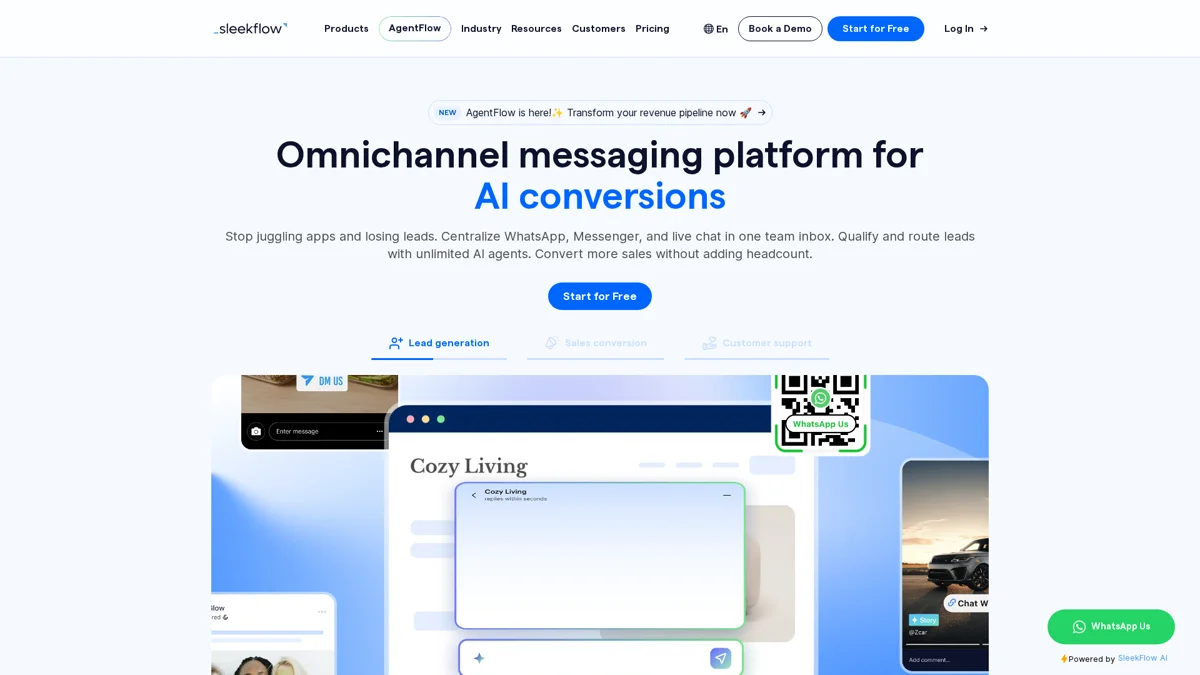
What features does Sleekflow offer?
Sleekflow's feature set is built around what its target customer base values most — its biggest differentiator versus the alternatives below. It uses a usage-based pricing model starting at $109/mo, a different cost structure from a flat-rate alternative like Converge ($49/month for up to 15 agents, all channels and AI included). Features typically split across channel coverage, automation depth, AI tooling, and team management — the grid below shows what matters most for a unified-inbox use case.
Why should you look for Sleekflow alternatives?
Teams look for Sleekflow alternatives because of structural limitations in its plans and channel coverage — pain points that compound as the team scales past initial setup.
Most teams leave SleekFlow over cost shape rather than missing features. Two things changed in 2026 that matter more than anything on the feature grid: SleekFlow's own tiers were restructured, and Meta started charging for the messages support teams send most.
Where does SleekFlow's tier structure bite first?
Not on seats any more. Both paid tiers carry 10 user accounts, so the 3-user wall that dominated SleekFlow comparisons through mid-2026 no longer exists. What separates Pro from Premium is integration depth and governance: HubSpot and Zoho sync, webhooks, the ticketing system and role-based access control are all Premium. A Pro workspace therefore runs 10 agents on one permission level, where every agent can see and do everything.
Email is now a partial gap rather than a total one. SleekFlow shipped an email channel during 2026 and still labels it beta behind a Feature preview toggle. It connects Microsoft 365, Outlook, Gmail or Google Workspace mailboxes over OAuth, or gives you a SleekFlow-hosted address, and it explicitly does not support manual IMAP or SMTP, custom email domains, signatures, email templates, email analytics, or email triggers in Flow Builder. For a support team that treats email as a real channel, that list is the thing to read before the price.
Migration friction is the third factor. Because SleekFlow is a Meta Business Solution Provider, your WhatsApp Business Account is hosted under its infrastructure, so leaving requires disabling two-factor authentication on the WABA and releasing the number, not just disconnecting an integration.
What did Meta's 1 October 2026 pricing change do to WhatsApp support costs?
It put a price on the half of WhatsApp support that used to be free, and it lands on every vendor rather than on SleekFlow specifically.
Two changes took effect on 1 October 2026, both documented by Meta. Service messages — the ordinary free-form replies an agent sends inside the 24-hour customer service window — became billable per message, having been free since 1 November 2024. Utility templates sent in response to a customer inside that window became billable too, having been free since 1 July 2025. Meta sets service rates equal to each market's utility and authentication rate and offers no volume tiers on them, but does include a free monthly allowance of 1,000 delivered service messages per business phone number, which resets monthly and does not roll over. Separately, since 1 August 2026, messages powered by Meta's own Business Agent are billed per token at $2.00 per million, which Meta estimates at 4-5 cents per message.
SleekFlow publishes the new rate card in its own help centre, which makes the size of the change checkable rather than theoretical. A service reply costs $0.0034 in North America, $0.0220 in the United Kingdom, $0.0550 in Germany, $0.0068 in Brazil and $0.0014 in India — each of which read "Free" on the same table before October. Work a realistic support month: 3,000 agent replies on one number, minus the 1,000 free, leaves 2,000 chargeable. That is $6.80 a month in North America, $44 in the UK and $110 in Germany, against $0 previously. The free allowance is per phone number, so a second number brings a second 1,000.
Two practical consequences. First, the change is close to a rounding error for a US-focused team and a real line item for a Western European one, so a blanket "WhatsApp got more expensive" is the wrong summary. Second, Meta required a payment method on file by 30 September 2026 and stated it would stop delivering service messages for accounts without one — worth confirming with any BSP you are evaluating, including your current one.
What does the channel coverage comparison look like?
SleekFlow leans toward Asian markets: WhatsApp, WeChat, LINE, Viber, Telegram, Instagram, Messenger, SMS, TikTok, VoIP calling, the beta email channel and a live chat widget. WeChat requires a Service Account with an annual verification fee of roughly $99 and allows only four broadcasts a month outside its 48-hour window. Discord and Zalo do not appear in the published channel list.
Converge covers WhatsApp, Telegram, Discord, Instagram, Zalo OA, Messenger, X, email and its own widget, with AI reply suggestions, visitor tracking with UTM attribution, and lead capture included at $49/month flat. Its email channel connects your own mailbox over IMAP and SMTP, which is the connection method SleekFlow's beta does not offer. It has no social commerce layer — no in-chat payments, no product catalogs, no cart, and no voice. The two products overlap on the inbox and diverge on whether the job is selling or supporting.
Strengths
- Strong Asia-Pacific focus
- Good e-commerce integrations
- WeChat support
- Email and voice calls now sit in the same inbox
Limitations
- No free plan on the published pricing page — the entry point is a 7-day trial that pauses the workspace on day 8
- Headline price is the annual rate; month-to-month runs roughly a quarter higher
- Monthly active contact overage tops up automatically in blocks of 100
- Premium has no self-serve checkout, so anything above Pro goes through a demo
How much does Sleekflow cost?
Sleekflow pricing starts at $109/mo on a usage-based model — but that listed price rarely reflects what teams actually pay. Real cost depends on team size and how the model scales with headcount, channel count and per-channel surcharges, premium-tier gating that surfaces after signup, and add-ons for advanced reporting, premium support, or compliance. The tier breakdown below lists what each plan includes alongside its monthly price.
Every figure below was re-checked against SleekFlow's live pricing page on 20 September 2026, and most of them moved since the last check. The headline $109 is the yearly-billed rate, both paid tiers now include 10 user accounts, and there is no longer a free plan.
What does each SleekFlow tier actually cost?
SleekFlow prices three tiers and leads with the annual rate on all of them. The page's toggle advertises "save 20%" and prints the annual total next to a struck-through figure, which is what makes the month-to-month rate recoverable.
- Pro — $109/month billed yearly ($1,308/year), against a struck-through $1,668 that works out to $139/month month-to-month. Includes 10 user accounts and 500 monthly active contacts to start, AI Agents, Flow Builder, broadcasts, Shopify and API access.
- Premium — $279/month billed yearly ($3,348/year), against a struck-through $4,188, or $349/month month-to-month. Same 10 user accounts, 1,000 MACs to start, plus HubSpot and Zoho sync, webhooks, ticketing, role-based access control and advanced analytics.
- Enterprise — custom, adding Salesforce, PII masking, multiple workspaces and conversation data export.
Three details are easy to miss. There is no free plan: the entry point is a 7-day Pro trial with no credit card, after which the workspace pauses entirely — no messages in or out, no automations, no API calls — until you subscribe. Premium has no self-serve checkout, so the button is "Book a Demo" and the real entry point is a sales call. And the 60-day dedicated onboarding, included with Premium, is sold separately as a $999 one-time package.
How does the monthly active contact model change your bill?
SleekFlow bills on monthly active contacts, not stored contacts. A contact counts when they message you, or when you message them through the Inbox, Flow Builder, AI Agent, WhatsApp co-existence, or API. Someone who receives a one-way broadcast and never replies does not count, and storage is unlimited on every tier. Email threads count too: SleekFlow's help centre notes that a contact's first email thread in a billing period makes them a MAC.
That model is fairer than per-contact billing, but it makes your bill move with engagement rather than headcount — the opposite of a per-seat tool. SleekFlow's own estimate is that a business chatting with 20 unique customers a day uses about 450 MACs a month, which sits just under Pro's 500. Exceed it and there is no wall and no decision to make: SleekFlow adds 100 MACs at a time automatically for that billing month, then resets. Convenient during a campaign spike, and the reason to watch the invoice rather than the dashboard.
The "unlimited" labels on AI usage, broadcasts, and Flow Builder are all governed by a Fair Use Policy that SleekFlow says affects under 1% of users.
What does WhatsApp add on top?
SleekFlow's pricing page lists a WhatsApp Business API number hosting fee of $15/month, with conversation rates charged per its own rate card; VoIP and SMS numbers are $1/month each. Meta's per-message rates are billed separately through a credit wallet that suspends messaging if the balance goes negative.
So a monthly-billing Pro team with one WhatsApp number starts at $154/month ($139 + $15) before any message fees. The same team on yearly billing is $124/month, but pays a full year up front. Since 1 October 2026 those message fees include agent replies inside the 24-hour window, above a free allowance of 1,000 service messages per number per month.
Converge is $49/month flat for up to 15 agents with no contact metering and no per-number hosting fee. Meta's message rates apply on any platform — they are Meta's charge, not the vendor's.
What are the top Sleekflow alternatives?
Side-by-side breakdown of features, pricing, and trade-offs.
The top Sleekflow alternatives split into two categories serving different team profiles. First, messaging-first unified-inbox platforms built for 3-15 agent teams handling real-time conversations across channels — Converge sits in this category at $49/month flat. Second, traditional ticketing and helpdesk platforms built for larger teams with email-heavy or compliance-heavy workflows. The comparison below covers features, pricing model, and best-fit team type for each.
Converge
Best ValueMessaging-first unified inbox. Flat pricing, all channels included.
Strengths
- $49/month flat rate for up to 15 agents
- Native WhatsApp, Telegram, Messenger, Discord, Zalo
- Unified inbox for real-time conversations
Limitations
- No standalone knowledge base
- Not suited for email-heavy workflows
- No HIPAA/SOC2 compliance

Zendesk
Customer service software and support ticketing system
Strengths
- Industry-leading ticketing system with mature workflows
- Marketplace of 1,800+ apps, partners and integrations
- Enterprise-grade security and compliance (HIPAA, SOC2)
Limitations
- Per-agent pricing scales quickly -- add-ons can double the per-seat rate
- AI Copilot is $50/agent/mo extra on top of base plan
- AI resolutions above the plan allowance are billed per resolution at an unpublished rate

Freshdesk
Cloud-based customer support software by Freshworks
Strengths
- Mature platform with proven reliability at scale
- Email-only teams can pay $19/agent/mo rather than buying messaging they will not use
- Strong automation and workflow capabilities
Limitations
- Two separate product lines priced differently — pick the wrong one and messaging costs a migration, not an upgrade
- Omnichannel messaging requires Omni plans ($29+/agent/mo)
- AI Copilot is $29/agent/mo extra and unavailable at all on Growth or Omni Growth

Intercom
AI-first customer service platform
Strengths
- Fin AI Agent resolves queries autonomously with high accuracy
- Beautiful, modern interface design
- Strong product tour and in-app onboarding features
Limitations
- Per-outcome Fin AI fees ($0.99 each) add up fast at volume
- Premium per-seat pricing plus Pro and Proactive Support add-ons can reach $150+/seat/mo effective
- No Zalo channel in Intercom's channel list

Help Scout
Customer service platform for growing businesses
Strengths
- Clean, intuitive interface loved by support teams
- Excellent email-focused support with collision detection
- Strong knowledge base (Docs) for self-service
Limitations
- WhatsApp only available on Plus tier ($45/user/mo)
- No native Telegram, Discord, or Zalo support
- AI Answers charged per resolution ($0.75 each)
How do Sleekflow alternatives compare?
Compared head-to-head, Converge ($49/month flat for up to 15 agents) is consistently the cheapest option for messaging-first teams under 15 agents and includes WhatsApp, Telegram, Messenger, Instagram, Discord, and Zalo plus AI tooling in the base subscription. The other major Sleekflow alternatives use per-seat models that scale linearly with headcount, compounding past the 3-5 agent threshold. The table below shows starting prices and best-fit profiles for each alternative.
Which Sleekflow alternative is best for messaging-first SMBs?
For messaging-first SMBs under 15 agents, Converge is consistently the best Sleekflow alternative on the dimensions that matter in practice. It includes native support for WhatsApp, Telegram, Messenger, Instagram, Discord, and Zalo Official Accounts at $49/month flat for up to 15 agents — no per-seat fees, no per-channel add-ons, no premium-tier gating around AI features. The verdict below shows where teams choose Converge and where a different platform fits better.
If your team primarily uses messaging channels (WhatsApp, Telegram, Messenger, Instagram, Discord, Zalo) and wants predictable pricing, Converge is worth considering.
Why teams choose Converge
- $49/month flat rate for up to 15 agents
- Native messaging channels most treat as add-ons
- Unified inbox for real-time conversations
When to choose something else
- Enterprise compliance (HIPAA, SOC2)
- Email/ticket-heavy workflows
- Advanced automation requirements
Do not switch away from SleekFlow if any of these describe you. You run outbound broadcast campaigns as a revenue channel — SleekFlow's broadcast engine, Flow Builder abandoned-cart recovery, and Stripe payment links have no equivalent in a support-first inbox, and replacing them means buying a second tool. You depend on WeChat, LINE, or Viber; those channels are genuinely hard to find elsewhere, and losing them to save on subscription cost is a bad trade. You use AI Agents to close conversations autonomously rather than to assist a human. Or your usage sits comfortably inside the MAC allowance on yearly billing — at $124/month all-in for a team of up to 10 with one WhatsApp number, the saving from switching is real but modest against migration effort that includes a BSP-level WhatsApp release.
Switch if the metering, not the feature set, is the problem. The clearest signals: your MAC usage spikes with campaigns and the automatic 100-contact top-ups keep landing on the invoice; you are paying month-to-month and carrying roughly a quarter premium for it; email is a real support channel for you and the beta's missing signatures, templates and analytics rule it out; or you need Discord or Zalo, neither of which appears in SleekFlow's channel list. Those are pricing-model and coverage problems, and no amount of SleekFlow configuration fixes them.
Converge fits the second group specifically: $49/month flat for up to 15 agents, no contact metering, email connected to your own mailbox over IMAP or SMTP, plus Discord and Zalo. It is not a commerce platform and has no voice channel, and if you recognized yourself in the first paragraph, stay where you are.
See our breakdown of switching away from Intercom for more.Frequently Asked Questions
SleekFlow's pricing page, checked on 20 September 2026, shows Pro at $109/month and Premium at $279/month, both on yearly billing. The annual totals printed on the same cards are $1,308 and $3,348, against struck-through figures of $1,668 and $4,188 — which work out to $139 and $349 a month, the monthly-billing rates SleekFlow is discounting against. Both paid tiers include 10 user accounts; Pro starts at 500 monthly active contacts and Premium at 1,000. On top of the subscription, each WhatsApp number carries a $15/month hosting fee and Meta's per-message rates are billed separately, so a monthly-billing Pro team with one WhatsApp number starts at $154/month before a single template message. VoIP and SMS numbers are $1/month each.
From 1 October 2026, Meta charges per message for service messages — the ordinary free-form replies an agent sends inside WhatsApp's 24-hour customer service window — and for utility templates sent in response to a customer inside that window. Service replies had been free since 1 November 2024, utility-in-window since 1 July 2025. Meta's documentation sets service rates equal to each market's utility and authentication rate, with no volume tiers, and adds a free monthly allowance of 1,000 delivered service messages per business phone number that does not roll over. SleekFlow publishes the same rate card in its own help centre: a service reply costs $0.0034 in North America, $0.0220 in the United Kingdom and $0.0550 in Germany, against $0.00 before. This is Meta's charge rather than SleekFlow's, so it reaches every WhatsApp vendor equally — it simply lands harder on a WhatsApp-first platform, because more of that platform's traffic is inbound support replies.
No. As of 20 September 2026 SleekFlow's pricing page lists three tiers — Pro, Premium and Enterprise — and no perpetual free plan. What replaced it is a 7-day Pro trial with no credit card required, covering 500 monthly active contacts and every Pro feature. SleekFlow's own FAQ is blunt about day 8: miss the deadline without subscribing and the workspace pauses, with no messages in or out, no automations and no API calls, although the data is retained. Comparisons still describing a free tier with 50 monthly active contacts and a live chat widget are out of date.
Go to Contacts in the side menu, navigate to the specific list you want to export, click More actions, then select Export list. SleekFlow generates a CSV with all contact properties as column headers. Export progress appears at the bottom left of the screen. Exports are per-list — repeat for each contact list separately.
SleekFlow's Analytics > Conversations tab has an Export button that generates a CSV with daily aggregated metrics (conversations, messages, response times) for up to 180 days. This is aggregated data, not raw message-level history. For individual message data, use the Platform API (Integrations > Platform API > Connect, admin access required) which covers Contacts, Messaging, Inbox, and Analytics modules.
Two methods: (1) On the Broadcasts page, hover over a campaign, click the three-dot menu, and select Export .CSV. (2) Open a broadcast's settings, go to the History tab, and click Export .CSV in the top right. The CSV includes per-recipient data: contact name, delivery status (Sent/Delivered/Read/Replied/Failed), phone number, labels, last updated, and remarks. WeChat, SMS, and Telegram channels do not report Read delivery status.
Flow Builder automations (visual workflows, triggers, branching logic), AI Agent configurations (knowledge base files, custom answers, action settings), label hierarchies, custom objects, assignment rules, and quick reply templates cannot be exported through any method. Screenshot your Flow Builder workflows, note your label structure, and manually copy canned response text before canceling.
The top Sleekflow alternatives are Zendesk, Freshdesk, Intercom, and Converge. Each offers different strengths: Zendesk for Large enterprises needing comprehensive ticketing, and Converge for messaging-first teams with flat $49/month pricing.
Sleekflow starts at $109/mo. Additional costs may include add-ons, annual billing requirements, and implementation fees.
Sleekflow can work for small businesses. Alternatives like Converge offer flat-rate pricing ($49/month for up to 15 agents) better suited for SMBs.
Sleekflow's main limitations include: No free plan on the published pricing page — the entry point is a 7-day trial that pauses the workspace on day 8; Headline price is the annual rate; month-to-month runs roughly a quarter higher; Monthly active contact overage tops up automatically in blocks of 100. These factors lead many teams to explore alternatives.
Sleekflow at $109/mo is on the higher end compared to alternatives. Zendesk starts at $19/seat/mo. Converge offers flat $49/month for up to 15 agents, eliminating per-seat scaling.
Ready to try Converge?
$49/month flat. Up to 15 agents. 7-day free trial, no credit card required.
Start Free Trial