
Dixa Alternatives 2026
Dixa is a Copenhagen-founded customer service platform acquired by Calabrio in 2024. It holds a 4.2/5 rating from 391 reviews on G2 and earned 30 new G2 Spring 2026 badges (dixa.com/blog, February 2026). Dixa now brands itself as 'the agentic CS platform' for ecommerce — clients include Rapha, ALLSAINTS, HAY, and Too Good To Go. The core differentiator is queue-less routing: conversations are assigned to agents based on skills, workload, and priority rather than traditional ticket queues. The Mim AI Agent went omnichannel in Q1 2026 with a built-in reliability watchdog, and Dixa claims 80%+ autonomous resolution rates (dixa.com/blog, March 2026). Dixa Knowledge, a centralized knowledge management hub, launched in 2026 to power both agent self-service and Mim's responses (dixa.com). AI products (Mim, Co-Pilot, QA, Voice Transcription) are all priced as separate add-ons on every plan. No native mobile app exists — agents use a mobile-optimized web interface (eesel.ai review, May 2026).

Messaging-first unified inbox with flat pricing. WhatsApp, Telegram, Messenger, Discord, Zalo in one place.
Zendesk is customer service software and support ticketing system. Best suited for large enterprises needing comprehensive ticketing with compliance requirements and deep third-party integrations. Known for its industry-leading ticketing system with 1000+ integrations and enterprise-grade compliance.
Freshdesk is Freshworks' customer support platform, sold as two separate product lines: standard Freshdesk (email-first ticketing, $19-$89/agent/mo) and Freshdesk Omni (messaging plus ticketing, $29-$119/agent/mo). We re-checked both Freshworks pricing pages on 5 August 2026 — the long-running Free plan is gone from the public rate card and survives only as an in-app, six-month, two-agent Free Program on the standard line. Freddy AI is the standout, but Copilot is a $29/agent/mo add-on on top of whichever plan you pick.
Intercom is an AI-first customer service platform best suited for well-funded SaaS companies that want product tours, in-app messaging, and an AI agent that answers front-line questions. Checked 3 August 2026: the three per-seat plans (Essential, Advanced, Expert) still list at $29, $85, and $132 per seat annually, and Fin AI still bills $0.99 per outcome — so the headline seat price is rarely the real cost. Two things did change this year: the company renamed itself Fin in May 2026, and Salesforce signed a definitive agreement to acquire it in June 2026. The helpdesk product keeps the Intercom name.
Help Scout is customer service platform for growing businesses. Best suited for small-medium businesses wanting a clean, email-focused helpdesk with strong knowledge base and self-service features. Known for its docs knowledge base with AI Answers for self-service resolution.
Dixa is a Copenhagen-founded customer service platform acquired by workforce intelligence company Calabrio in 2024. It holds a 4.2/5 rating from 391 reviews on G2 and earned 30 new G2 Spring 2026 badges (dixa.com/blog, February 2026). Dixa now positions itself as "the agentic CS platform" for ecommerce brands — clients include Rapha, ALLSAINTS, HAY, Oliver Bonas, and Too Good To Go. The defining feature is queue-less routing: conversations are assigned to agents based on skills, workload, and priority across phone, email, chat, WhatsApp, Messenger, Instagram, and SMS from a single workspace called Team Hub. Growth at $89/agent/month (annual) or $109/agent/month (monthly) is the entry point after Dixa removed the Essential tier in 2025 (dixa.com/pricing, May 2026). AI capabilities are all separate add-ons: Mim AI Agent went omnichannel in Q1 2026 with a built-in watchdog for reliability monitoring, and Dixa claims 80%+ autonomous resolution rates (dixa.com/blog, March 2026). Dixa Knowledge, a centralized KB product, launched in 2026 to feed both agent self-service and Mim's responses from one source of truth (dixa.com). AI Co-Pilot (smart replies, summaries, translation) and Quality Assurance remain per-seat add-ons with unpublished pricing. Dixa does not offer a native mobile app — agents access the platform through a mobile-optimized web interface (eesel.ai review, May 2026).
Converge is a messaging-first inbox at $49/month flat for up to 15 team members with AI reply suggestions included. The structural difference: Dixa is a contact center platform with native voice, IVR, and call recording built for omnichannel operations; Converge is a messaging inbox built for chat-based support with visitor tracking and lead capture. One Dixa agent seat on the Growth plan costs more than Converge's entire monthly subscription for a full team.
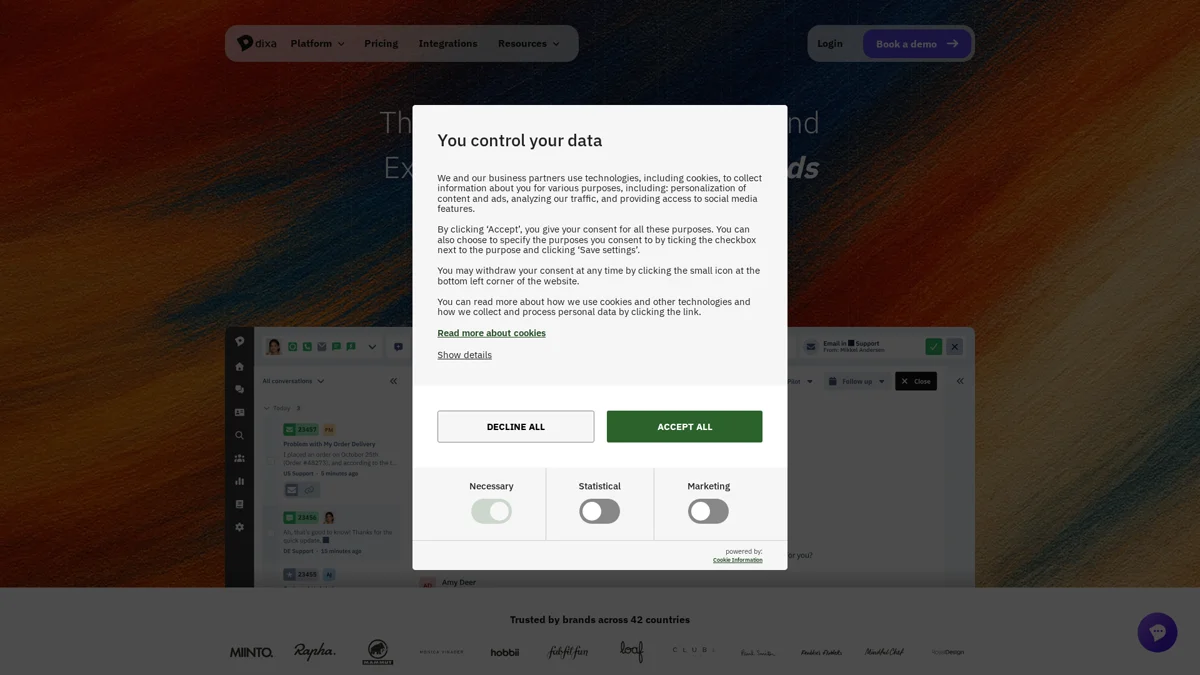
What features does Dixa offer?
Dixa's feature set is built around what its target customer base values most — its biggest differentiator versus the alternatives below. It uses a per seat pricing model starting at From $89/seat/mo, a different cost structure from a flat-rate alternative like Converge ($49/month for up to 15 agents, all channels and AI included). Features typically split across channel coverage, automation depth, AI tooling, and team management — the grid below shows what matters most for a unified-inbox use case.
Why should you look for Dixa alternatives?
Teams look for Dixa alternatives because of structural limitations that reviewers on G2 and Capterra consistently flag — pain points that compound as the team scales past initial setup.
Dixa's core strength is the Team Hub — a unified agent workspace where phone calls, emails, live chats, and social messages are handled from one interface. The queue-less routing engine assigns conversations based on agent skills, availability, and customer priority without traditional ticket queues. The Automation Builder (Dixa's current branding for what was previously the Flow Builder) provides node-based routing logic for IVR menus, business hours rules, queue assignment, and external data routing (Ultimate plan and above). Side Conversations let agents loop in external parties mid-interaction. Macros require the Ultimate plan at $139/agent/month. Multiple Organization support is locked behind Prime at $179/agent/month (dixa.com/pricing, May 2026).
Dixa Knowledge launched in 2026 as a centralized knowledge management hub that powers both agent-facing articles and Mim AI Agent responses from a single source of truth (dixa.com). This replaces the earlier external/internal knowledge base split. Dixa's AI features remain entirely add-on based. Mim AI Agent went omnichannel in Q1 2026 — it now resolves inquiries across chat, email, and social (previously chat-only), with Dixa claiming 80%+ autonomous resolution rates. A built-in watchdog feature monitors AI reliability and flags when Mim's confidence drops (dixa.com/blog, March 2026). AI Co-Pilot provides GPT-powered smart replies, summaries, translations, spellchecking, and a writing assistant. Quality Assurance and AI Auto QA monitor conversations with scorecards. Voice Transcription converts calls to searchable text. None of these ship with any plan — pricing requires contacting sales (dixa.com/pricing, 2026). CloudTalk's pricing analysis (March 2026) confirms that Dixa's Growth plan lacks AI tools, automation workflows, and sandbox access; teams wanting those features must upgrade to Ultimate ($139/agent/month) or Prime ($179/agent/month). Dixa does not offer a native mobile app for iOS or Android — agents use a mobile-optimized web version instead (eesel.ai review, May 2026).
Converge covers messaging channels Dixa does not support: native Discord, Zalo, and Telegram. AI reply suggestions with configurable tone (professional, friendly, casual) and quick reply matching are included at $49/month with no add-on fees — agents can also bring their own API key. The chat widget provides visitor tracking, UTM attribution, beacon tracking, lead capture with lifecycle stages, FAQ self-service, and CSAT surveys. Converge does not include voice, IVR, call recording, workforce management, the Automation Builder, or an autonomous chatbot. The products address different operational models: Dixa is a contact center; Converge is a messaging inbox.
Strengths
- True omnichannel with native voice
- Queue-less intelligent routing
- Mim AI Agent with omnichannel support and reliability watchdog (Q1 2026)
- Calabrio WFM integration
Limitations
- Per-agent pricing ($89–$179/agent/mo)
- AI features are all paid add-ons
- No self-serve free trial
- No native Telegram, Discord, or Zalo
How much does Dixa cost?
Dixa pricing starts at From $89/seat/mo on a per seat model — but that listed price rarely reflects what teams actually pay. Real cost depends on team size and how the model scales with headcount, channel count and per-channel surcharges, premium-tier gating that surfaces after signup, and add-ons for advanced reporting, premium support, or compliance. The tier breakdown below lists what each plan includes alongside its monthly price.
Dixa pricing as of May 2026 (per agent, billed annually / billed monthly) from dixa.com/pricing. The Essential tier was removed in 2025 — Growth is now the entry point:
- Growth: $89/agent/month (annual) or $109/agent/month (monthly) — all channels (phone, email, chat, social), external knowledge base, SLA monitoring, survey measurement, business hours, native integrations (Salesforce, HubSpot, Shopify), intelligent routing, unlimited queues
- Ultimate: $139/agent/month (annual) or $169/agent/month (monthly) — adds routing with external data, standard AI intent detection (300 chars), advanced automations, macros, Knowledge-Centered Service, sandbox access, third-party AI integrations
- Prime: $179/agent/month (annual) or $215/agent/month (monthly) — adds SSO (included rather than add-on), advanced AI intent detection (1,000 chars), advanced insights, custom user roles, multiple organizations, enterprise API limits
AI products are separate add-ons across all tiers: Mim AI Agent (autonomous chatbot, priced by conversation volume), AI Co-Pilot (smart replies, summaries, translation — priced per seat), Quality Assurance, AI Auto QA, and Voice Transcription. SSO is an add-on on Growth and Ultimate, included only on Prime. Collaboration User seats and Seasonal Agent seats are paid add-ons on all plans. Dixa does not publish add-on pricing — you must contact sales (dixa.com/pricing, May 2026). No self-serve free trial is available; Dixa requires booking a demo to discuss trial options.
A 5-agent team on Growth (annual): $445/month. On Ultimate (for macros and automations): $695/month. On Prime (for SSO and multi-org): $895/month. Add AI Co-Pilot and Mim, and costs exceed $1,000/month before factoring in AI agent volume charges. A 15-agent team on Growth: $1,335/month. Converge: $49/month flat for up to 15 agents with AI reply suggestions included and a 7-day free trial requiring no credit card. A 15-agent team on Dixa Growth pays 27× more than Converge for messaging support.
What are the top Dixa alternatives?
Side-by-side breakdown of features, pricing, and trade-offs.
The top Dixa alternatives split into two categories serving different team profiles. First, messaging-first unified-inbox platforms built for 3-15 agent teams handling real-time conversations across channels — Converge sits in this category at $49/month flat. Second, traditional ticketing and helpdesk platforms built for larger teams with email-heavy or compliance-heavy workflows. The comparison below covers features, pricing model, and best-fit team type for each.
Converge
Best ValueMessaging-first unified inbox. Flat pricing, all channels included.
Strengths
- $49/month flat rate for up to 15 agents
- Native WhatsApp, Telegram, Messenger, Discord, Zalo
- Unified inbox for real-time conversations
Limitations
- No standalone knowledge base
- Not suited for email-heavy workflows
- No HIPAA/SOC2 compliance

Zendesk
Customer service software and support ticketing system
Strengths
- Industry-leading ticketing system with mature workflows
- Massive integration ecosystem with 1000+ apps
- Enterprise-grade security and compliance (HIPAA, SOC2)
Limitations
- Per-agent pricing scales quickly -- add-ons can double the per-seat rate
- AI Copilot is $50/agent/mo extra on top of base plan
- AI resolutions above the plan allowance are metered at $1.50-$2.00 each

Freshdesk
Cloud-based customer support software by Freshworks
Strengths
- Mature platform with proven reliability at scale
- Email-only teams can pay $19/agent/mo rather than buying messaging they will not use
- Strong automation and workflow capabilities
Limitations
- Two separate product lines priced differently — pick the wrong one and messaging costs a migration, not an upgrade
- Omnichannel messaging requires Omni plans ($29+/agent/mo)
- AI Copilot is $29/agent/mo extra and unavailable at all on Growth or Omni Growth

Intercom
AI-first customer service platform
Strengths
- Fin AI Agent resolves queries autonomously with high accuracy
- Beautiful, modern interface design
- Strong product tour and in-app onboarding features
Limitations
- Per-outcome Fin AI fees ($0.99 each) add up fast at volume
- Premium per-seat pricing plus Pro and Proactive Support add-ons can reach $150+/seat/mo effective
- No native Telegram or Zalo support; Discord added natively in March 2026

Help Scout
Customer service platform for growing businesses
Strengths
- Clean, intuitive interface loved by support teams
- Excellent email-focused support with collision detection
- Strong knowledge base (Docs) for self-service
Limitations
- WhatsApp only available on Plus tier ($45/user/mo)
- No native Telegram, Discord, or Zalo support
- AI Answers charged per resolution ($0.75 each)
How do Dixa alternatives compare?
Compared head-to-head, Converge ($49/month flat for up to 15 agents) is consistently the cheapest option for messaging-first teams under 15 agents and includes WhatsApp, Telegram, Messenger, Instagram, Discord, and Zalo plus AI tooling in the base subscription. The other major Dixa alternatives use per-seat models that scale linearly with headcount, compounding past the 3-5 agent threshold. The table below shows starting prices and best-fit profiles for each alternative.
Which Dixa alternative is best for messaging-first SMBs?
For messaging-first SMBs under 15 agents, Converge is consistently the best Dixa alternative on the dimensions that matter in practice. It includes native support for WhatsApp, Telegram, Messenger, Instagram, Discord, and Zalo (the only platform with native Zalo integration) at $49/month flat for up to 15 agents — no per-seat fees, no per-channel add-ons, no premium-tier gating around AI features. The verdict below shows where teams choose Converge and where a different platform fits better.
If your team primarily uses messaging channels (WhatsApp, Telegram, Messenger, Instagram, Discord, Zalo) and wants predictable pricing, Converge is worth considering.
Why teams choose Converge
- $49/month flat rate for up to 15 agents
- Native messaging channels most treat as add-ons
- Unified inbox for real-time conversations
When to choose something else
- Enterprise compliance (HIPAA, SOC2)
- Email/ticket-heavy workflows
- Advanced automation requirements
Choose Dixa if:
- Your support operation requires native voice calling with IVR, call recording, voicemail, and callback scheduling
- You need queue-less routing — skill-based assignment, the Automation Builder with external data routing
- You want Mim AI Agent for autonomous resolution across chat, email, and social with a built-in reliability watchdog (Q1 2026 omnichannel update)
- You need Calabrio workforce management and quality assurance tools integrated with your service platform
- You need native Shopify and Magento integrations with order data embedded in the agent workspace
- Your budget supports $89–$179/agent/month plus AI add-ons, and your operation justifies a full contact center platform
Choose Converge if:
- Your customers communicate through messaging apps — WhatsApp, Telegram, Discord, Instagram, Zalo, Messenger
- You want $49/month flat pricing for up to 15 agents instead of $89+/agent/month per-seat billing
- You need native Discord, Telegram, or Zalo support (Dixa offers none of these)
- You want AI reply suggestions included at no extra cost — no add-on purchases, no per-seat AI charges
- You need visitor tracking with UTM attribution, beacon tracking, and lead capture in your chat widget
- You prefer a 7-day free trial with no credit card over Dixa's demo-required evaluation process
- Predictable pricing matters — no per-agent scaling, no AI add-on negotiations, no minimum seat requirements
Frequently Asked Questions
The top Dixa alternatives are Zendesk, Freshdesk, Intercom, and Converge. Each offers different strengths: Zendesk for Large enterprises needing comprehensive ticketing, and Converge for messaging-first teams with flat $49/month pricing.
Dixa starts at From $89/seat/mo. For a 5-person team, this costs approximately $445/month. Additional costs may include add-ons, annual billing requirements, and implementation fees.
Dixa can work for small businesses, though per-seat pricing scales with team size. Alternatives like Converge offer flat-rate pricing ($49/month for up to 15 agents) better suited for SMBs.
Dixa's main limitations include: Per-agent pricing ($89–$179/agent/mo); AI features are all paid add-ons; No self-serve free trial. These factors lead many teams to explore alternatives.
Dixa at From $89/seat/mo is on the higher end compared to alternatives. Zendesk starts at From $19/seat/mo. Converge offers flat $49/month for up to 15 agents, eliminating per-seat scaling.
Ready to try Converge?
$49/month flat. Up to 15 agents. 7-day free trial, no credit card required.
Start Free Trial